10 Things Every Content Creator Wishes They Knew Before Starting

Last updated: March 24, 2026
If you've ever felt paralyzed at the start of your content journey — staring at your phone wondering if your room looks good enough, your voice sounds right, or your camera is professional enough — you're not alone. Content creator tips for beginners flood every corner of the internet, but most skip the lessons that actually matter in year one. The ones that come from experience.
We spoke to creators at various stages of their journey and distilled the wisdom they wish had existed when they were just starting out. Whether your goal is YouTube, TikTok, Instagram Reels, or a podcast, these 10 lessons apply universally. Read them once. Save them. Come back when you're frustrated.
1. Stop Waiting for "Good Enough" Gear
The single most common thing experienced creators say? "I wish I'd started sooner." Not with better gear — just sooner. The phone in your pocket right now records in 4K. The camera you're eyeing on Amazon will not make your content better if your ideas aren't there yet.
Understanding what do you need to start making content comes down to this: a smartphone with a decent camera, a free editing app, and a quiet space. That's it. Every other tool is an upgrade you earn over time as your audience and skills grow together.
Gear is a crutch for creators who haven't committed yet. The best time to start was six months ago. The second best time is now — with whatever you have.
"My first 50 videos were filmed on a cracked iPhone 7. Three of them went viral. My camera had nothing to do with it." — a mid-tier YouTube creator with 180K subscribers
2. Consistent Framing Changes Everything
One of the most overlooked social media content creation tips is this: your audience forms a visual identity around your content before they consciously recognize it. That means the way you frame your shots — your distance from the camera, the angle, how much headroom you leave — becomes your brand fingerprint.
Watch any creator with over 100K followers and you'll notice their framing is almost identical video to video. This is intentional. Consistent framing does two things:
- It signals professionalism and intentionality to the viewer
- It speeds up your filming process because you're not repositioning every time
A simple rule: eyes at one-third from the top of the frame, camera at eye level or very slightly above. Mark your tripod position on the floor with tape. Never guess twice about the same setup.
3. Lighting Matters More Than Your Camera
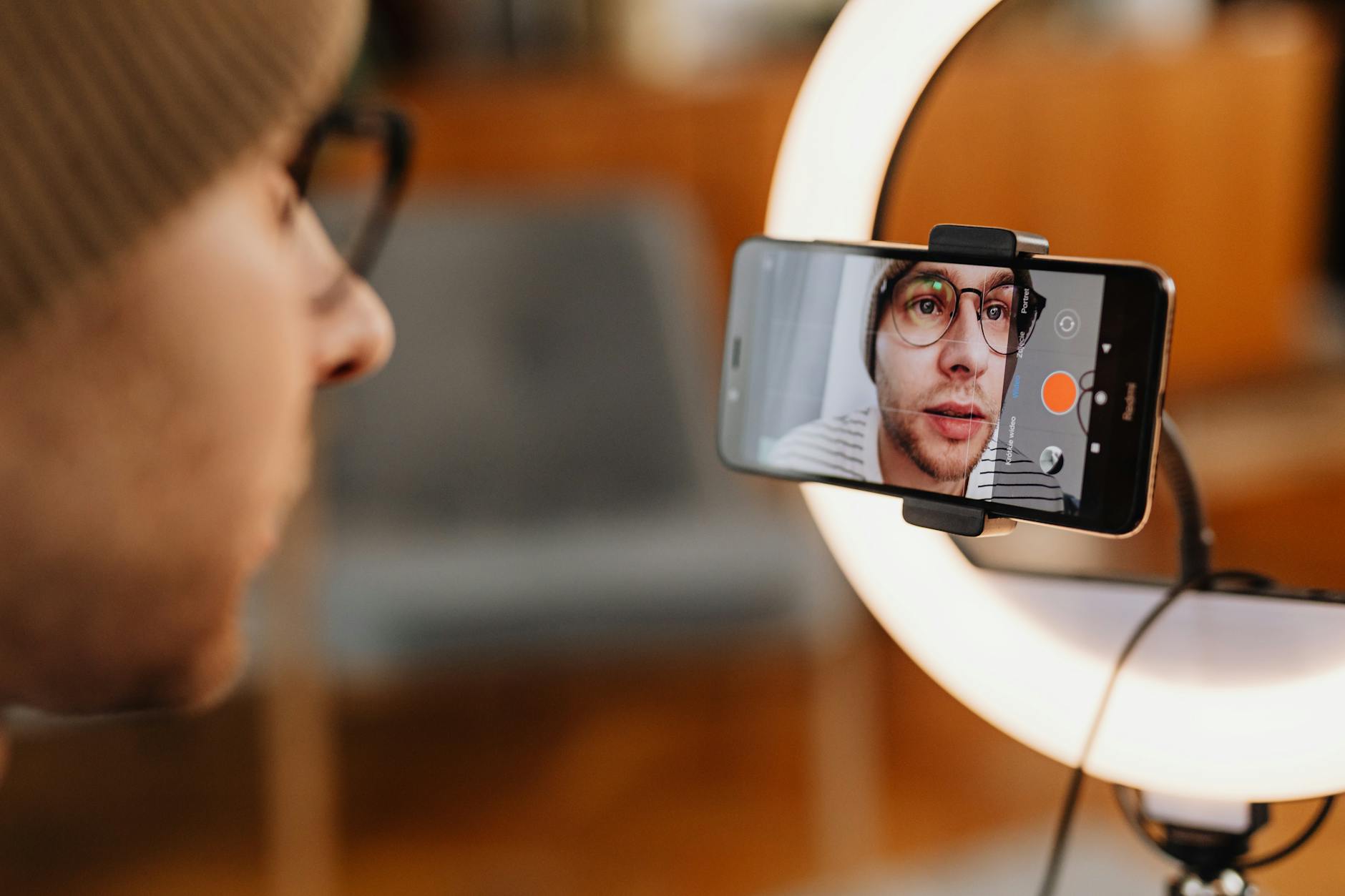
Ask any cinematographer what separates amateur footage from professional footage and they'll say the same word: lighting. Not resolution. Not lens quality. Light.
When you learn how to film better videos at home, lighting is the single variable that delivers the biggest return on effort. A $25 ring light or a well-placed window can make your iPhone footage look indistinguishable from a $2,000 mirrorless camera in a dark room.
Here's what actually works for home setups:
- Natural window light: Position yourself facing the window, not beside or behind it. Overcast daylight is the most flattering light source available — and it's free.
- Ring lights: Place them slightly above eye level, centered. Avoid getting too close or the catchlights in your eyes become distracting circles.
- Softboxes: The step up from ring lights. They spread light more naturally and reduce harsh shadows on one side of the face.
The fastest upgrade any beginner can make has nothing to do with buying a new camera. Move your desk to face the window. Shoot between 9am and 3pm. Watch what happens to your footage.
4. Audio Quality Is Non-Negotiable
Viewers will tolerate average video quality. They will not tolerate bad audio. This is one of those beginner content creator mistakes that costs real subscribers — because poor sound signals a lack of care, and audiences feel it immediately even if they can't name why they clicked away.
You don't need a professional microphone to start. But you do need to:
- Film in the quietest room available
- Record a test clip and listen back on headphones before filming your main content
- Add soft furnishings (rugs, curtains, bookshelves) to reduce echo
- Consider a $20–$40 lavalier mic clipped to your shirt — it's a bigger audio upgrade than any camera
A simple rule: if you wouldn't want to listen to your audio in a car with the volume up, reshoot it.
5. Batch Your Content — Don't Film Day by Day

One of the most transformative content creator tips for beginners is the concept of batching. Instead of filming one video, editing it, posting it, then repeating — you film multiple pieces of content in a single session, then edit them over the next day or two, then schedule them all at once.
Why does this matter? Because creative energy is lumpy. Some days you're "on." Your hair looks good, your energy is high, your ideas are flowing. Other days, you feel flat and forcing it shows on camera. Batching lets you harvest the good days and coast through the bad ones.
A practical batching framework for beginners:
- Plan: Write or outline 4–6 pieces of content in one sitting
- Film: Shoot all of them back-to-back in a single 2–3 hour session
- Edit: Process them across 2 editing sessions later in the week
- Schedule: Upload and queue them in your platform's scheduler
This approach also creates a content buffer — a safety net so you're never in a panic to post something just to stay visible.
6. The Hook Is Everything
The first 3 seconds of any video — or the first line of any post — determine whether a stranger becomes a viewer. Platform algorithms across YouTube, TikTok, and Instagram all weight "watch time" and "completion rate" heavily. If people click away in the first few seconds, your content gets buried regardless of how good the rest of it is.
Strong hooks answer one of three unspoken questions the viewer has:
- "What's in it for me?" — State the benefit or outcome immediately
- "Why should I keep watching?" — Create curiosity or tension
- "Is this person worth my time?" — Project confidence and energy from frame one
Avoid the classic beginner mistake of opening with: "Hey guys, welcome back to my channel, so today I'm going to be talking about..." That's seven seconds of information-free warm-up that costs you viewers every single time.
7. Thumbnail and Title Psychology Is a Real Skill
If you're creating for YouTube or any thumbnail-driven platform, your thumbnail and title are your content's storefront. They determine whether someone clicks at all — before they've seen a single second of your work.
Understanding thumbnail psychology is one of the most underrated aspects of how to start content creation effectively. The best thumbnails tend to share a few traits:
- One clear focal point — usually a face with visible emotion, or a dramatic image
- High contrast colors that pop against both light and dark backgrounds
- Minimal text — three to five words maximum, large enough to read on mobile
- Visual curiosity gap — the thumbnail implies something surprising or unresolved
A useful exercise: screenshot thumbnails from the top 10 videos in your niche. Lay them out in a grid and ask yourself what they have in common. Then ask what you can do differently to stand out in that same feed.
8. Consistency Beats Perfection — Every Time

This is possibly the most repeated piece of advice in content creation — and the most ignored. New creators spend three weeks perfecting one video instead of publishing three imperfect ones. But the data is clear: frequency builds skills, and skills build audiences.
Your 50th video will be dramatically better than your 5th, regardless of how much time you spend perfecting that 5th one. The only way to get to the 50th is to publish the imperfect ones in between.
Consistency also signals reliability to your audience. When someone discovers a creator and sees a regular publishing schedule, they're more likely to subscribe because they know more content is coming. A creator who posts sporadically trains their audience not to rely on them.
Pick a schedule you can realistically maintain — even if it's just once a week — and protect it the same way you'd protect a work deadline.
9. Niche Down Earlier Than Feels Comfortable
One of the most common beginner content creator mistakes is trying to appeal to everyone. "Lifestyle" channels that cover cooking, travel, skincare, fitness, and relationship advice all at once rarely find traction early on — because algorithms and audiences both reward specificity.
When someone stumbles across one of your videos and loves it, they visit your channel and ask one question: "Is there more of this?" If the answer is yes — if your content clearly lives in one space — they subscribe. If your channel looks like a random grab-bag of topics, they don't.
Niching down doesn't mean being boring. It means:
- Picking a content pillar that you can sustain for at least 100 videos
- Solving a specific problem for a specific type of person
- Being the "go-to" for something, rather than a generalist for everything
You can always expand your niche as your audience grows. But you need a home base first.
10. Treat It Like a Business From Day One
This is the mindset shift that separates creators who grow from creators who plateau. Even if you're just starting out, approaching social media content creation tips with a business mindset changes how you track, learn, and improve.
That doesn't mean monetizing immediately — it means:
- Tracking analytics: Which videos got the most views? Which had the best watch time? Why? Look at the data weekly, not just when something goes viral.
- Understanding your audience: Read every comment, especially early on. Your viewers will tell you exactly what they want more of — most creators don't listen.
- Reinvesting: When you can, upgrade the most impactful constraint. Not gear for gear's sake — identify your weakest link and address that specifically.
- Treating your channel as a portfolio: Even if it never monetizes, the skills you develop — on-camera presence, editing, storytelling, thumbnail design — are genuinely valuable in a dozen other career contexts.
Creators who see their channel as a hobby tend to take long breaks when it gets hard. Creators who see it as a business power through the tough stretches because they understand that every creative project has a trough before the breakthrough.
Key Takeaways for Beginner Content Creators
If you only remember a handful of things from this guide, let it be these:
- Your phone is already good enough — start now
- Good lighting transforms footage more than any camera upgrade
- Bad audio kills retention faster than anything else
- Nail your hook in the first 3 seconds or lose the viewer
- Batch your content to protect your consistency
- Publish consistently — 50 imperfect videos beat 5 perfect ones
- Niche down before you spread out
- Study your analytics like a business, not a hobby
Every experienced creator you admire went through exactly the same uncertainty you feel right now. The difference between those who broke through and those who didn't rarely came down to talent or gear. It came down to showing up, learning from the data, and refusing to quit before the compounding effect kicked in.
The best content creator tips for beginners ultimately reduce to one thing: start, stay consistent, and let time do the rest. The creators who figure that out in month one are the ones you'll be watching in two years.