Anything Speaker Review 2026: We Tested the Bone Conduction Gadget for 30 Days
Limited Time Offer!
Get This Deal Now → *Affiliate link - We may earn a commissionWhen the Anything Speaker landed on our test bench, the first thing we did was laugh. Not unkindly — but a device the size of a large marble claiming to be a serious audio tool naturally invites skepticism. The promise: stick it to any surface using bone conduction technology, and that surface becomes a speaker. A coffee table. A window. An empty wine bottle. It sounds like the kind of trick you'd see on a late-night infomercial and promptly forget. So we spent 30 days trying to prove — or disprove — every one of those claims.
This anything speaker review covers exactly what you need to know before spending $145.77 on what could either be the most clever pocket gadget of 2026 or an overpriced party trick.
Exclusive Discount Available Now
What Is the Anything Speaker and How Does It Work?
The Anything Speaker is a bone conduction Bluetooth speaker that measures just 1.5 inches across — roughly the size of a walnut. Instead of projecting sound through a traditional driver and cone, it uses a vibrating transducer to transmit sound waves directly into a hard surface. That surface then acts as the resonating chamber, producing audio the same way a wooden guitar body amplifies the vibration of its strings.
The physics are real. Bone conduction technology has been used in military headsets, medical hearing devices, and premium open-ear headphones for years. What the Anything Speaker does is apply that same principle outward — onto tabletops, windows, and hollow objects — rather than into your skull. Connect it via Bluetooth (30-foot range), press it against a surface, and the audio comes from the surface itself.
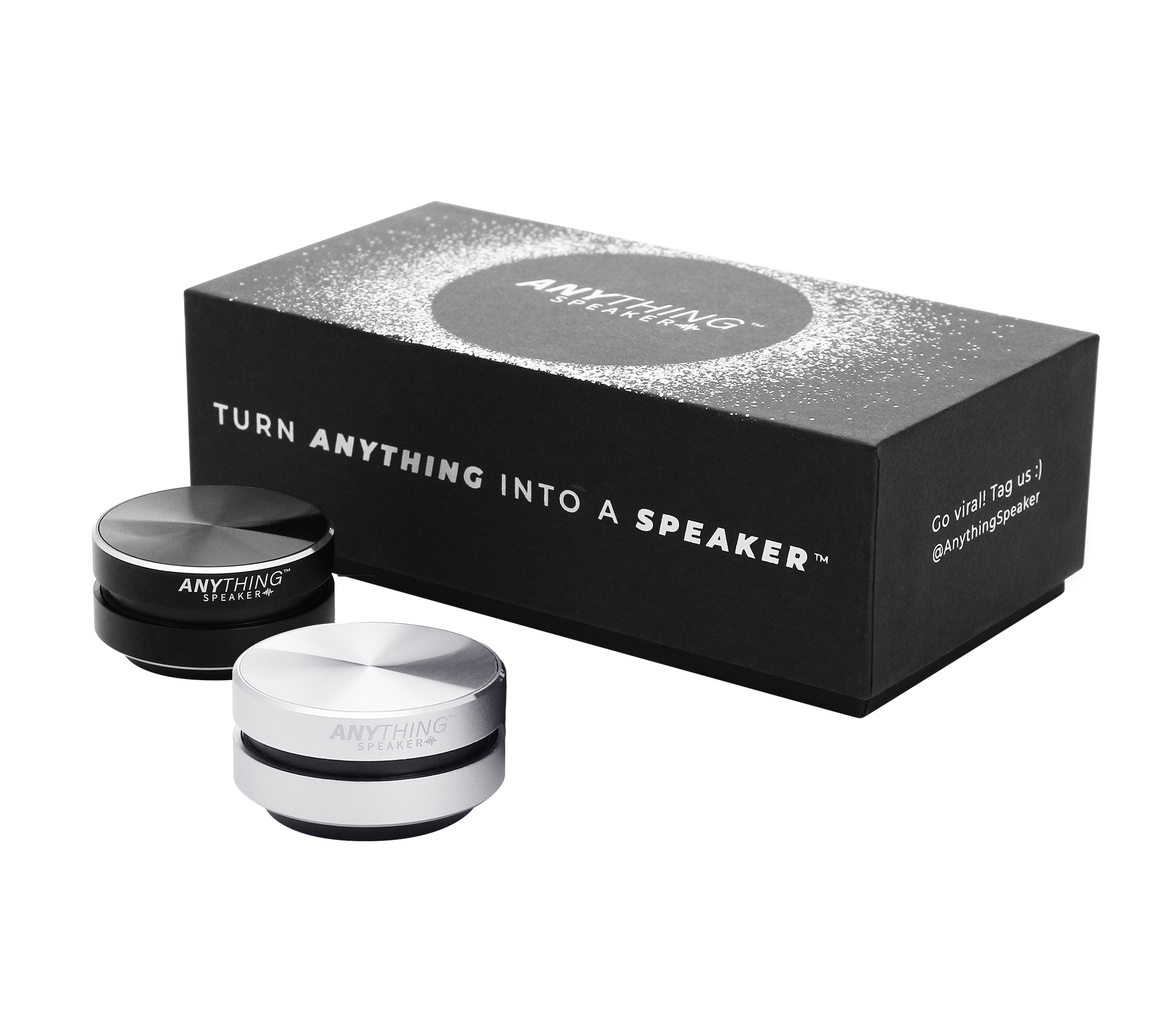
In the box you get the speaker unit, a magnetic mount, suction cup attachments, and an adhesive pad — three different ways to bond the speaker to a surface depending on what you're working with. Charging is handled via USB-C, and Anything Speaker claims up to 3 hours of battery life per charge.
The Anything Speaker in hand — it's genuinely tiny, roughly the size of a large coin
30-Day Test Log: Surface-by-Surface Results
We approached this like a field test, not a lab benchmark. Our goal was to find out which surfaces sounded good, which sounded mediocre, and which sounded terrible — and whether real-world battery life matched the advertised spec.
Surface Testing Results
| Surface | Volume Level | Bass Response | Clarity | Overall Rating |
|---|---|---|---|---|
| Solid oak dining table | Loud | Strong | Excellent | 9/10 |
| Glass window pane | Medium | Minimal | Crisp, bright | 7/10 |
| Empty wine bottle | Very loud | Boomy | Warm but muddy | 7.5/10 |
| Hollow acoustic guitar body | Extremely loud | Very strong | Impressive | 9.5/10 |
| Plastic storage bin | Moderate | Thin | Tinny | 5/10 |
| Ceramic coffee mug | Low | Negligible | Quiet, muffled | 4/10 |
| Wooden cutting board | Loud | Good | Very good | 8.5/10 |
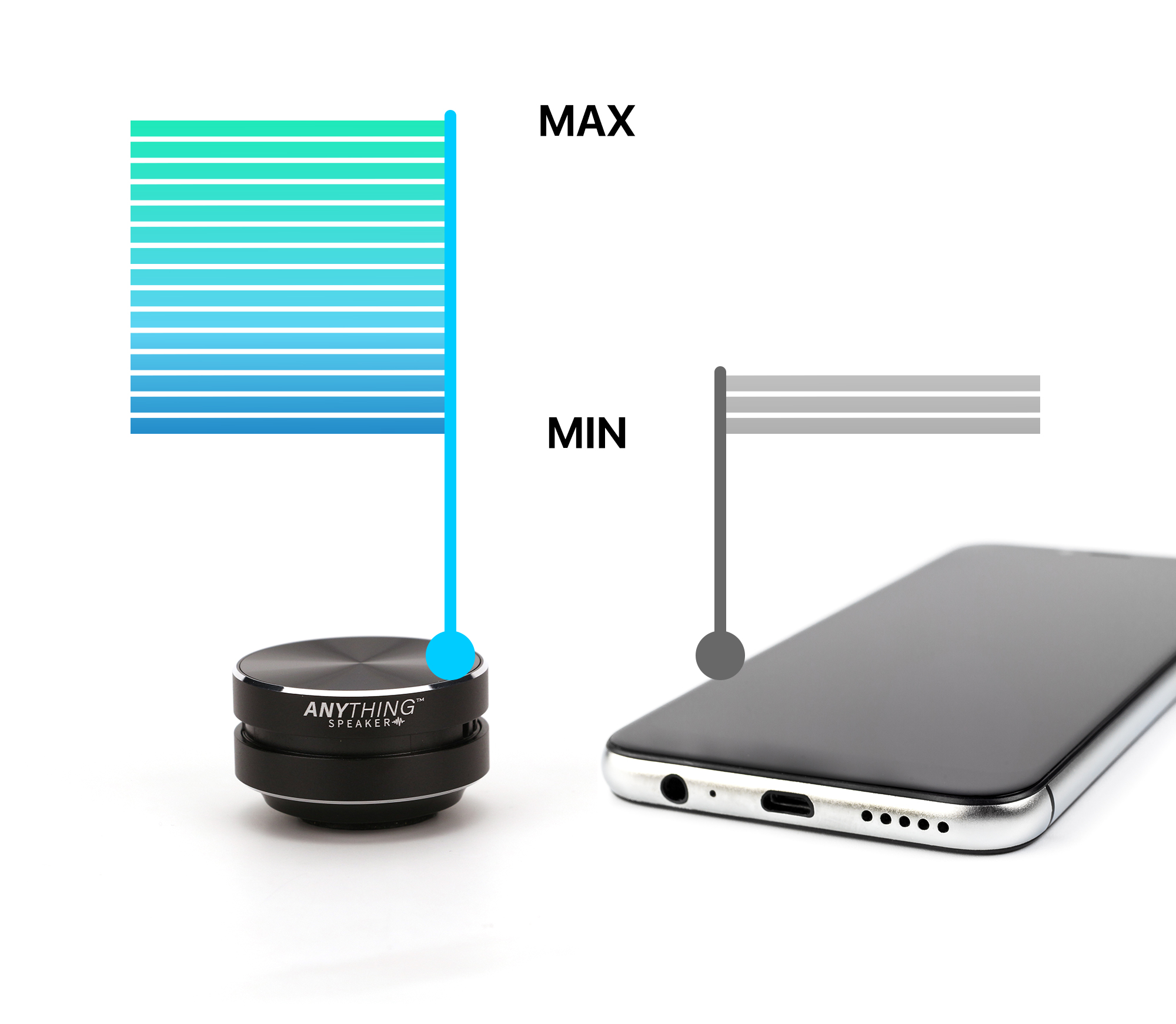
The takeaway from our surface testing is straightforward: the Anything Speaker rewards surfaces with natural resonance. Dense hardwoods, hollow wooden objects, and large glass panes all performed well. Thin plastics and small ceramic objects disappointed. The "300% amplification" marketing claim holds up specifically on large wooden surfaces — on a solid oak dining table, the volume genuinely surprised us. On a plastic bin, not so much.
In-Home Use: A Month of Living with the Anything Speaker
Beyond the surface tests, we integrated the Anything Speaker into a normal home routine for four weeks. A few observations stood out.
Kitchen use was a highlight. Stuck to the wooden kitchen table during cooking sessions, it provided clear, surprisingly room-filling background music. The 30-foot Bluetooth range meant a phone could stay on the counter while the speaker sat anywhere on the table without dropouts. We never once had a connection issue across a standard-size kitchen and living room combo.
Bathroom use via suction cup on the mirror was convenient but sonically average. Glass mirrors resonate differently than windows — thicker and smaller — so the result was decent volume with limited bass. Fine for podcasts, less satisfying for music.
Battery life in real use hit 2 hours 45 minutes at moderate-to-high volume, which is slightly under the 3-hour claim. At lower volumes it can stretch to just over 3 hours. For a device this small, that's acceptable — it's not competing with the 10-hour runtime of a JBL Charge, but it's not pretending to be that device either.
Pairing two Anything Speakers together for 360-degree stereo was one of the genuinely exciting features. With one unit on each end of a coffee table, the stereo imaging was legitimately impressive — the separation felt wider than most single-point Bluetooth speakers at any price. This is actually where the product finds its strongest use case: as a paired stereo system placed directly on your furniture.
Pairs Available — Biggest Savings on Multi-Packs
Anything Speaker vs. $20 JBL Clip: The Honest Comparison
This is the question that defines whether the Anything Speaker is worth buying. A JBL Clip 4 costs around $30 retail, fits in a pocket, and produces consistent, predictable, good-sounding audio from a traditional driver. So why would anyone spend $145 on the Anything Speaker?
The answer depends entirely on what you value.
Where the JBL Clip wins: Raw, consistent audio quality regardless of environment. You get the same dependable sound on a hiking trail, at the beach, or on a hard surface. It's also more weather-resistant and better suited to outdoor use. If your primary use case is music while exercising, traveling, or doing outdoor activities, the JBL is the sensible choice at a fraction of the price.
Where the Anything Speaker wins: It's a fundamentally different experience. When you place it on a large hardwood table and the whole table starts producing music, it's genuinely magical — and no JBL can replicate that. The bone conduction speaker technology turns your environment into the instrument, which creates a room-filling, diffuse sound that doesn't point at you from a single source. In a living room or kitchen, that feels more natural and social. The conversation-starter factor is also real — every person who visited during our 30-day test was visibly amazed when we demonstrated it on a wooden surface.
The $145 vs. $30 gap is substantial. But they're not really competing products — one is a portable outdoor speaker, the other is an at-home acoustic novelty with genuine utility. If you want a conversation piece that actually works well in the right conditions, the Anything Speaker earns its price. If you want a versatile everyday speaker, the JBL wins by default.
Pros and Cons After 30 Days
Pros
- Genuinely impressive on hardwood surfaces
- Ultra-compact — truly pocket-sized
- 30-foot Bluetooth range with zero dropouts in testing
- Dual pairing for stereo sound is excellent
- Multiple attachment options (magnet, suction, adhesive)
- Remarkable conversation starter and educational tool
- 30-day money-back guarantee
Cons
- Battery life slightly under advertised (2h 45m vs 3h)
- Sound quality highly surface-dependent
- Thin plastics and ceramics produce poor results
- $145 price tag requires the right buyer
- Not suitable for outdoor or on-the-go use
- No IPX water resistance rating mentioned
Who Should Buy the Anything Speaker?
After 30 days, we have a clear picture of who gets the most out of this device.
It's a strong buy if you: spend a lot of time at home and want a unique listening experience, love hosting and want a conversation piece that doubles as entertainment, live in a space with hardwood furniture or surfaces, want to use it as a paired stereo system on a coffee table, or are buying for a tech-curious kid or hobbyist interested in acoustics.
Skip it if you: primarily want a portable speaker for outdoor activities, need consistent audio quality in varied environments, already have a speaker setup you're happy with, or are budget-conscious — a $30 JBL Clip delivers better value for pure portability.
The anything speaker review community on Reddit mirrors our experience — users who love it tend to be home listeners who discovered a great hardwood surface. Users who are disappointed tend to have expected it to replace a conventional speaker for all use cases.
Frequently Asked Questions
Final Verdict
After 30 days with the Anything Speaker, our verdict is this: it's not a novelty. It's a legitimate, innovative product — but it's a niche one. The bone conduction speaker technology is real, the results on hardwood surfaces are genuinely impressive, and the dual-pair stereo mode on a coffee table is one of the most unique listening experiences we've encountered at any price point.
The honest caveat: you need to know your surfaces. Place it on a dense wooden table and prepare to be amazed. Stick it on a plastic tray and prepare to be underwhelmed. At $145.77, it sits in a price tier that demands consistent performance — and consistent performance requires the right environment.
We give the Anything Speaker 8 out of 10. It earns that score because it does exactly what it promises in the right conditions, offers a completely distinct experience from any conventional speaker, and backs it up with a 30-day money-back guarantee. If you have the surfaces for it, it's worth every cent. If you live in a space full of carpet, upholstery, and plastic furniture, save your money for a JBL.
Overall Rating: 8/10
Best for home listeners with hardwood surfaces. Unique bone conduction experience backed by a 30-day guarantee.
Get the Anything Speaker — Check Current Price30-Day Money-Back Guarantee | Bundles Available
Ready to Get Started?
Don't miss out on this exclusive offer!
Claim Your Discount → *This is an affiliate link. We may earn a commission at no extra cost to you.