Best Acne Treatment for Sensitive and Rosacea-Prone Skin in 2026
Limited Time Offer!
Get This Deal Now → *Affiliate link - We may earn a commissionIf you have both acne and rosacea, you already know the frustration: every acne product that promises results also promises a new wave of redness, burning, and flare-ups that leave your skin worse than before. You are not imagining it. You are not being overly sensitive. You are dealing with a genuinely underserved skin concern — one that conventional acne treatments are literally not designed to address. Finding the best acne treatment for sensitive skin with rosacea requires a completely different framework than what most products offer.
Standard acne treatments are formulated for one problem at a time. They assume your skin can handle aggression. Yours cannot. This guide breaks down exactly why that is, what to look for in a safe alternative, and why a new class of treatment — nanofiber DrySerum technology — is changing the game for people dealing with acne and rosacea at the same time.
Why Having Acne and Rosacea at the Same Time Is Its Own Category
Acne and rosacea are two distinct inflammatory skin conditions that share some surface-level similarities — redness, bumps, congested pores — but are driven by completely different biological mechanisms. Acne is caused by excess sebum, clogged follicles, and the proliferation of C. acnes bacteria. Rosacea is a chronic vascular and inflammatory condition that causes persistent facial redness, visible blood vessels, and extreme sensitivity to external triggers.
When both occur together, the skin is in a state of compounded inflammation. The barrier is already compromised from rosacea. The immune response is already overactivated. Introducing a harsh acne treatment into this environment does not "fix" the acne — it triggers the rosacea, floods the skin with additional inflammation, and often results in a prolonged flare that can last days or weeks.
Common rosacea and acne triggers that overlap include:
- Alcohol-based toners and astringents
- Benzoyl peroxide at concentrations above 2.5%
- Retinoids (tretinoin, adapalene) that cause initial purging
- Physical and chemical exfoliants
- Fragranced formulas
- Heat-generating treatments like clay masks
This is why so many people dealing with acne and rosacea at the same time cycle through product after product with no lasting success. The industry has not caught up to this population yet — until now.
Why Standard Acne Products Are Contraindicated for Rosacea-Prone Skin
Let's be specific about the most common acne treatment ingredients and why they are problematic for sensitive, rosacea-prone skin.
Benzoyl Peroxide (BP): BP works by generating free radicals that kill acne-causing bacteria. But those same oxidative processes cause significant inflammation and barrier disruption — precisely what rosacea skin cannot handle. Many dermatologists now advise rosacea patients to avoid BP entirely, or use only ultra-low concentrations with careful monitoring.
Salicylic Acid (high concentration): At 2% and above, salicylic acid can be effective for comedone clearing, but it also lowers skin pH dramatically and strips natural lipids from the barrier. For rosacea-prone skin, this translates directly into burning, stinging, and redness amplification. The delivery method matters just as much as the concentration.
Retinoids: Vitamin A derivatives are widely recommended for acne, but the initial "purging" phase — which can last 4 to 12 weeks — involves significant peeling, dryness, and inflammation. For a rosacea sufferer, that purging phase can trigger a severe and prolonged flare.
Clay and Charcoal Masks: These work by physically drawing sebum out of pores through absorption. The drying effect is powerful enough to stress already-fragile rosacea skin, and the warmth generated during application is itself a known rosacea trigger.
Alcohol, Witch Hazel, and Astringents: Included in countless "oil control" products, these ingredients evaporate quickly and feel clarifying in the short term — but they disrupt the skin's acid mantle and signal the body to produce more oil to compensate, creating a cycle of dehydration and breakouts.
The core problem: virtually every mainstream acne product is designed to strip, dry, or aggressively exfoliate. Rosacea-prone skin needs the opposite — support, barrier reinforcement, and calm, targeted delivery of actives.
What Ingredient Properties Actually Work for This Skin Type
If you have rosacea-prone or extremely sensitive skin with acne, the right formula needs to hit a very specific brief. Here is what to look for — and what the science says about each:
Azelaic Acid: This is arguably the single most important ingredient for people dealing with acne and rosacea simultaneously. Azelaic acid for rosacea and acne is backed by decades of clinical research. It kills acne bacteria, reduces keratin buildup in pores, and — crucially — has documented anti-inflammatory and vasoconstrictive properties that directly address rosacea redness. It is the rare dual-action ingredient that does not compromise barrier integrity.
Niacinamide: A form of vitamin B3, niacinamide reduces sebum production, calms inflammatory pathways, strengthens the ceramide-rich skin barrier, and fades post-inflammatory hyperpigmentation (PIH) — a common aftereffect of acne flares on sensitive skin. It does all of this without any known irritation potential at standard concentrations.
Low-Dose Salicylic Acid (with controlled delivery): The problem with salicylic acid is not always the ingredient itself — it is the delivery system. When salicylic acid is applied in a high-concentration liquid or leave-on gel, it pools on the surface and disrupts the barrier. But when it is delivered deep into the follicle in a controlled, slow-release format, the comedone-clearing benefit can be achieved without the surface disruption. The delivery mechanism is everything.
Fragrance-Free, Alcohol-Free, Preservative-Free Formulation: For reactive skin, each of these categories represents a potential trigger. A formula free from all three eliminates a significant layer of risk.
Barrier-Repairing Properties: A treatment that simultaneously clears acne and fortifies the barrier — rather than stripping it — addresses both the symptom (the breakout) and the underlying vulnerability (compromised barrier function) that makes reactive skin more prone to future breakouts.
This set of requirements narrows the field significantly. Most products check one or two of these boxes. Very few check all of them. That is the problem Vanish DrySerum was specifically engineered to solve.
Vanish DrySerum: Built for the Acne-Rosacea Overlap
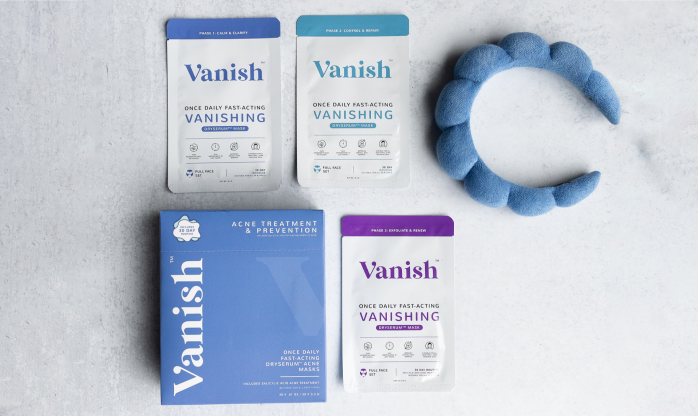
Vanish DrySerum is the first acne treatment built on patented nanofiber DrySerum™ technology — a delivery system that fundamentally changes how active ingredients reach your skin. Instead of a cream, gel, or liquid that sits on the surface and relies on passive absorption, the DrySerum mask dissolves on contact with skin in approximately 10 seconds, driving actives — salicylic acid, azelaic acid, and niacinamide — up to 8 times deeper than traditional topical formats.
That depth advantage matters for two reasons. First, it means the active ingredients are delivered directly into the follicle where acne originates, rather than pooling on the surface. Second, it means the skin's surface barrier is not saturated with high concentrations of actives — eliminating the burning, peeling, and surface irritation that rosacea-prone skin cannot tolerate.
This is what makes it the best acne treatment for sensitive skin with rosacea: the nanofiber format physically bypasses the surface irritation problem, while the ingredient stack — built around azelaic acid and niacinamide — specifically targets rosacea inflammation at the same time it clears acne.
Clinical Testing: Zero Burning, Peeling, or Irritation
For people with sensitive or rosacea-prone skin, claims about "gentle" formulas mean very little without data to back them up. Virtually every acne brand labels itself as gentle. The difference with Vanish DrySerum is that it has been clinically tested specifically for tolerability — and the results showed zero burning, zero peeling, and zero irritation across the trial participants.
This is not a minor detail. Clinical testing on tolerability is the benchmark that separates a product designed for sensitive skin from a product that merely uses gentle-sounding marketing language. When a gentle acne mask is clinically tested for the absence of irritation, it means dermatologists and researchers have specifically verified it does not cause the adverse reactions that standard acne treatments routinely produce in this skin type.
For rosacea patients in particular, this is the threshold question. Before efficacy, the first question has to be: will this make my rosacea worse? The clinical data on Vanish DrySerum answers that question directly.
Clinically Tested | No Burning | 45-Day Money-Back Guarantee
Key Features at a Glance
- Patented nanofiber DrySerum™ technology — delivers actives 8x deeper than creams
- 10-second dissolving application — no rinse, no wait, no mess
- Triple active formula — salicylic acid, azelaic acid, niacinamide
- Clinically tested — zero burning, peeling, or irritation in trials
- Safe for rosacea-prone, sensitive, combination, oily, hormonal, and cystic acne skin
- Free from harsh chemicals, parabens, fillers, and preservatives
- 45-day money-back guarantee — full refund if it does not work for you
Who Should Use Vanish DrySerum?
This product is specifically suited for people who:
- Have been diagnosed with rosacea and still experience acne breakouts
- React badly to benzoyl peroxide, retinoids, or high-concentration salicylic acid
- Experience burning, stinging, or flushing after applying standard acne treatments
- Have tried "gentle" or "sensitive skin" acne products that still cause flares
- Have reactive skin that seems to worsen no matter what they try
- Want a clinically backed solution rather than trial-and-error with drugstore options
It is also well-suited for hormonal acne, cystic breakouts, combination skin, and anyone whose skin barrier has been compromised by over-cleansing, overuse of actives, or environmental stressors.
Azelaic Acid and Niacinamide: The Rosacea-Safe Acne Stack
It is worth spending a moment on why the specific ingredient combination in Vanish DrySerum is significant for this skin type. Azelaic acid for rosacea and acne is listed in multiple dermatological treatment guidelines as a first-line option — one of very few actives that addresses both conditions simultaneously. At appropriate concentrations, it inhibits the enzyme responsible for melanin overproduction (addressing PIH), reduces the bacterial load that drives acne, and dampens the inflammatory vascular response associated with rosacea flushing.
Paired with niacinamide — which reinforces barrier lipids, reduces trans-epidermal water loss (TEWL), and calms the inflammatory cascade — the combination creates a treatment environment that is the opposite of what harsh acne products deliver. Rather than creating controlled damage to force the skin to "turn over," this stack supports the skin's natural repair mechanisms while eliminating the microbial and comedogenic factors that cause breakouts.
The salicylic acid component handles the comedone-clearing function — dissolving the keratin plugs that trap sebum in follicles — but delivered via nanofiber technology rather than a leave-on liquid, which is what allows it to work without the surface-stripping side effects.
This is what a formula that genuinely understands the acne and rosacea at the same time problem looks like: not a repurposed standard acne treatment, but a purpose-built solution that works with compromised, inflamed skin rather than against it.
The 45-Day Guarantee: Risk-Free for Skeptics
If you have been burned by acne products before — both metaphorically and, in the case of rosacea flares, literally — the 45-day money-back guarantee matters. It removes the financial risk of trying something new on reactive skin. You have more than six weeks to evaluate whether the treatment is actually delivering results without triggering your rosacea, and if it does not meet your expectations, you get a full refund.
For a product category where so much depends on individual skin response, this kind of guarantee is an important signal that the brand stands behind the clinical data.
45-Day Money-Back Guarantee — No Risk to Try
Frequently Asked Questions
Final Verdict
If you have been struggling with the best acne treatment for sensitive skin with rosacea, the answer is not to keep cycling through standard products and hoping one happens to be gentle enough. The standard product category is not designed for you. The ingredient profiles, concentrations, and delivery systems assume a skin type that can tolerate aggression — and yours cannot.
What this skin type needs is a formulation built from the ground up for the acne-rosacea overlap: azelaic acid for dual-action anti-inflammatory and antibacterial effects, niacinamide for barrier reinforcement and sebum control, salicylic acid delivered at depth rather than saturating the surface, and a delivery system — nanofiber DrySerum™ technology — that gets actives where they need to go without causing the surface disruption that triggers rosacea.
Vanish DrySerum is the only product currently on the market that checks every one of those boxes and backs it with clinical tolerability data showing zero burning, peeling, or irritation. For people who have been burned by every other option, that combination is not a minor upgrade — it is a fundamentally different approach.
With a 45-day money-back guarantee, there is no downside to finding out whether it works for your skin.
Exclusive Discount Available — 45-Day Money-Back Guarantee
Ready to Get Started?
Don't miss out on this exclusive offer!
Claim Your Discount → *This is an affiliate link. We may earn a commission at no extra cost to you.