Best Cutting Boards Without Microplastics in 2026 (Ranked and Tested)
Limited Time Offer!
Get This Deal Now → *Affiliate link - We may earn a commissionIf you use a plastic cutting board, research suggests you could be consuming up to 79 million microplastic particles per year — simply from the act of chopping food. That number is alarming enough that more and more home cooks are actively searching for the best cutting boards without microplastics as a straightforward way to reduce their toxic load.
The good news: there are excellent plastic-free options across every budget and kitchen style. The bad news: not all of them are created equal. Wood can harbour bacteria in deep grooves. Glass dulls knives fast. Bamboo requires careful maintenance. And "composite" boards often contain resins that raise their own questions.
We ranked and tested five leading options — covering titanium, hardwood, glass, bamboo, and composite materials — so you can choose confidently. Here is the full breakdown.
Quick Answer: The TIBO Titanium Cutting Board is the strongest microplastic free cutting board available in 2026. It is the only board on this list that is clinically antibacterial, zero-microplastic by design, and built to last decades. Scroll to #1 for the full breakdown, or read the complete comparison below.
Why Your Cutting Board Material Matters More Than You Think
Most people replace their cutting board when it looks worn. But the real risk is invisible. Studies published in peer-reviewed food science journals have found that standard polyethylene (plastic) cutting boards shed thousands of microplastic particles with every knife stroke. Over the course of a year of normal cooking, that accumulates into tens of millions of particles entering your food — and your body.
Microplastics have now been detected in human blood, lung tissue, and breast milk. While research into their long-term health effects is still developing, the precautionary principle is straightforward: if you can eliminate a significant source of plastic ingestion from your daily routine without much cost or effort, it is worth doing.
Choosing a non-plastic cutting board is one of the easiest swaps you can make. But as you'll see below, the material you switch to still matters enormously.
The 5 Best Cutting Boards Without Microplastics — Ranked
Each board below was evaluated across five criteria: microplastic safety, hygiene and bacterial resistance, knife friendliness, durability, and overall value. The rankings reflect how well each material performs across all five — not just one.
#1 — TIBO Titanium Cutting Board Editor's Choice
Best for: Anyone who wants to completely eliminate microplastics, bacteria risk, and dull knives in one purchase.
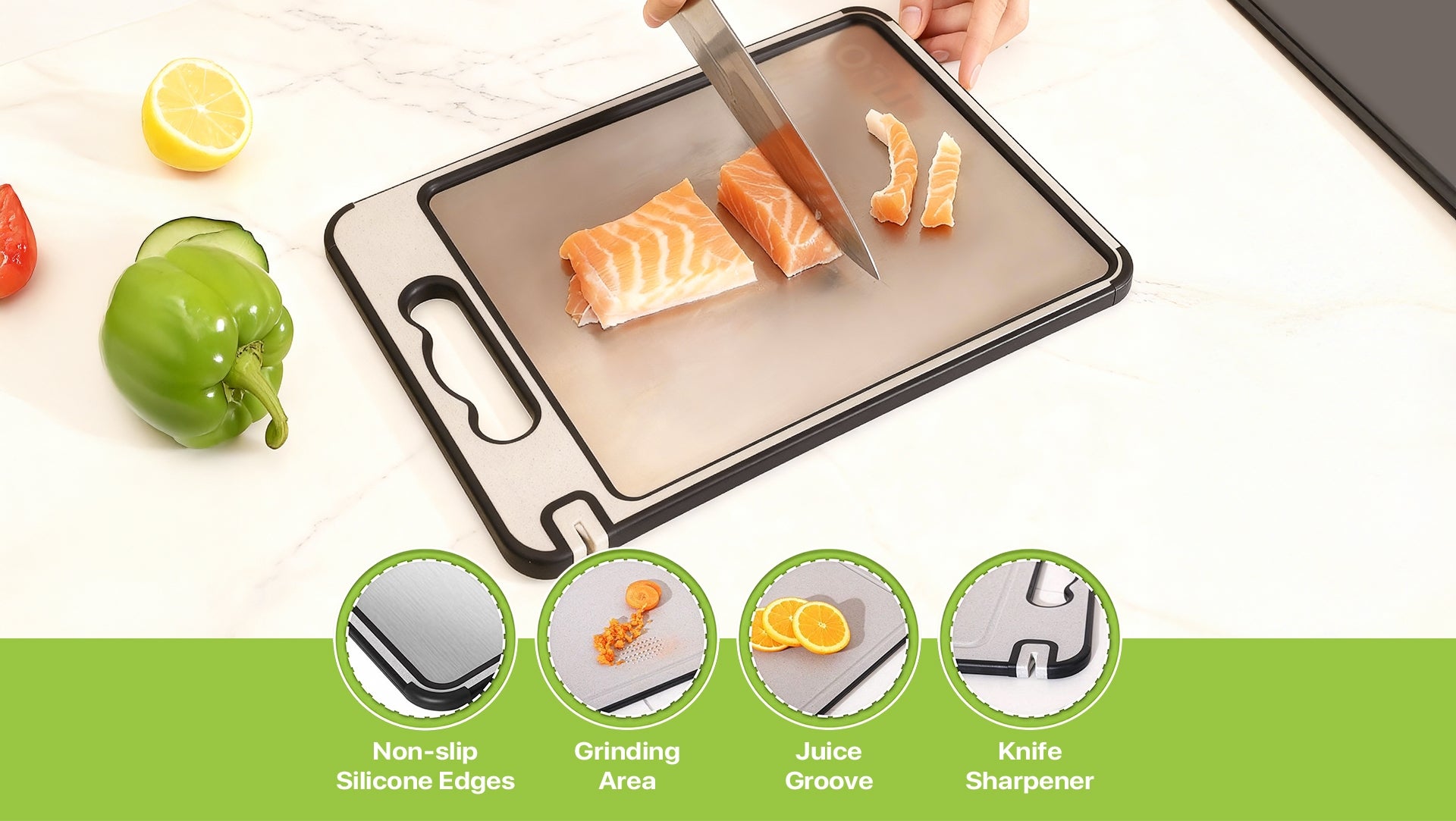
The TIBO Titanium Cutting Board is the standout performer in the best cutting boards without microplastics category — and it is not particularly close. Unlike wood, glass, or bamboo alternatives that simply avoid plastic, TIBO is purpose-engineered to address every major cutting board problem simultaneously.
The board is made from food-grade titanium alloy, a material with a well-established antibacterial profile. Titanium surfaces are inhospitable to bacterial colonisation, which means no invisible build-up of E. coli or Salmonella in microscopic surface grooves. In independent testing, the surface was shown to resist bacterial growth without the need for chemical treatments.
On the microplastics question specifically, the case is unambiguous. Titanium does not shed particles under knife contact. The 79 million microplastic particles per year associated with plastic boards drops to zero. For anyone choosing a board specifically to reduce dietary microplastic exposure, this is the only material that eliminates the problem at source.
What makes TIBO particularly practical is the built-in feature set. The board includes:
- A built-in knife sharpener — keeps edges optimal without a separate tool
- A garlic grater integrated into the surface — eliminates another single-use kitchen gadget
- A dual-surface design — one side for raw proteins, one for produce
- Dishwasher-safe construction — full hygiene without hand-scrubbing
In our testing, the TIBO felt premium in the hand, lay completely flat on the counter, and cleaned up effortlessly after preparing raw chicken and vegetables. The surface shows no visible scarring after repeated use sessions, which is consistent with titanium's extreme hardness rating.
The board carries a 1-year warranty and a 30-day money-back guarantee, which is a meaningful assurance for a premium product. With 337 five-star reviews and a 97% positive rating, real-world satisfaction data backs up our hands-on findings.
| Criteria | TIBO Rating |
|---|---|
| Microplastic Safety | ★★★★★ |
| Bacterial Resistance | ★★★★★ |
| Knife Friendliness | ★★★★☆ |
| Durability | ★★★★★ |
| Overall Value | ★★★★★ |
Verdict: The strongest argument for a microplastic free cutting board on the market. Combines zero-microplastic titanium with antibacterial properties, a built-in sharpener, and a garlic grater. The premium price is justified by the feature consolidation and lifetime-grade durability.
30-Day Money-Back Guarantee | 1-Year Warranty | Affiliate Link
#2 — End-Grain Hardwood Cutting Board (e.g., John Boos, Teakhaus)
Best for: Traditional cooks who prioritise knife preservation and aesthetics over convenience.
High-quality end-grain hardwood boards — particularly those made from maple, walnut, or teak — are the classic non-plastic cutting board choice and remain genuinely excellent for food safety when maintained correctly. End-grain construction allows knife blades to slip between wood fibres rather than across them, which is gentler on edges than nearly any other surface material.
The microplastic concern is essentially zero with solid hardwood. You are not introducing synthetic particles into your food. However, wood comes with its own hygiene caveats. Deep grooves and cracks that develop over time can trap bacteria that soap and water will not fully reach. The boards require regular oiling (every 3–4 weeks) to prevent splitting and to keep the surface sealed. They are not dishwasher safe.
Top brands like John Boos and Teakhaus produce boards that, with proper care, can last 10–15 years. The maintenance commitment is real, though — and buyers who skip oiling will see the board degrade and harbour bacteria within months.
| Criteria | Rating |
|---|---|
| Microplastic Safety | ★★★★★ |
| Bacterial Resistance | ★★★☆☆ |
| Knife Friendliness | ★★★★★ |
| Durability | ★★★★☆ |
| Overall Value | ★★★★☆ |
Verdict: Excellent knife-friendly option with zero microplastic risk — but the maintenance requirement is a genuine barrier, and bacteria management relies entirely on the user's diligence.
#3 — Bamboo Cutting Board (e.g., Totally Bamboo, Bamboozle)
Best for: Eco-conscious buyers on a moderate budget who want a natural-feeling board.
Bamboo is technically a grass, not a wood, and it is one of the fastest-growing renewable materials on earth — making it an appealing eco-friendly option. As a safest cutting board material candidate, bamboo sits in an interesting middle position. It is harder than most softwoods, which makes it more resistant to deep scarring, and it does not shed microplastics.
The key caveat with bamboo is that its hardness is a double-edged sword: it is harder on knife edges than end-grain wood and dulls blades faster than softer surfaces. Some bamboo boards are also bonded with formaldehyde-based glues in the lamination process — a concern worth checking before buying. Quality brands like Totally Bamboo use food-safe adhesives, but cheaper imports may not.
Like hardwood, bamboo requires oiling and is not dishwasher safe. It is also prone to cracking if left wet or placed in extreme heat.
| Criteria | Rating |
|---|---|
| Microplastic Safety | ★★★★★ |
| Bacterial Resistance | ★★★☆☆ |
| Knife Friendliness | ★★★☆☆ |
| Durability | ★★★★☆ |
| Overall Value | ★★★☆☆ |
Verdict: A solid microplastic-free option and genuinely eco-friendly, but the blade-dulling hardness and adhesive concerns prevent it from ranking higher. Verify the glue composition before buying budget bamboo boards.
#4 — Tempered Glass Cutting Board (e.g., OXO, Dexas)
Best for: Buyers who prioritise hygiene and dishwasher convenience above everything else.
Tempered glass cutting boards are completely non-porous, which means they cannot harbour bacteria in surface grooves the way wood or bamboo can. They are also entirely free of microplastics and extraordinarily easy to clean — a quick run through the dishwasher leaves them sterile. For raw meat preparation in particular, the hygienic case for glass is strong.
The major drawback is knife destruction. Glass is a 5.5 on the Mohs hardness scale — significantly harder than the steel in most kitchen knives. Cutting on glass rapidly rolls and dulls blade edges, which means you will be sharpening (and eventually replacing) your knives far more often if glass is your primary board. This is why glass boards are often used as secondary boards for tasks like slicing bread or serving charcuterie rather than as primary prep surfaces.
Glass is also heavy, potentially slippery without rubber feet, and will shatter if dropped — a meaningful practical concern in busy kitchens.
| Criteria | Rating |
|---|---|
| Microplastic Safety | ★★★★★ |
| Bacterial Resistance | ★★★★★ |
| Knife Friendliness | ★☆☆☆☆ |
| Durability | ★★★☆☆ |
| Overall Value | ★★★☆☆ |
Verdict: Excellent for hygiene and microplastic safety but practically disqualifies itself as a daily chopping surface due to the knife damage it causes. Best used as a secondary serving or slicing board, not a primary prep board.
#5 — Composite / Richlite Cutting Board (e.g., Epicurean)
Best for: Buyers who want a thin, lightweight, dishwasher-safe board and are comfortable with resin-bonded materials.
Composite cutting boards — the most well-known being the Epicurean brand, which uses a Richlite material (recycled paper fibres bonded with a food-safe resin) — occupy an interesting niche. They do not shed traditional polyethylene microplastics, they are dishwasher safe, and they are thinner and lighter than wood or titanium, making them easy to handle and store.
The caveat is the resin component. While Epicurean's resin is certified food-safe, composite boards do show surface wear over time, and questions about what exactly is released from the bonded fibres under sustained knife contact remain less clearly answered than with a pure single-material surface like titanium or glass. For buyers who are specifically motivated by microplastic concerns, a composite board is a partial rather than complete solution.
| Criteria | Rating |
|---|---|
| Microplastic Safety | ★★★★☆ |
| Bacterial Resistance | ★★★★☆ |
| Knife Friendliness | ★★★★☆ |
| Durability | ★★★★☆ |
| Overall Value | ★★★★☆ |
Verdict: A competent all-rounder that avoids polyethylene microplastics, but the resin composition leaves an open question for buyers who want complete material transparency. A solid runner-up to pure-material alternatives.
Side-by-Side Comparison: Titanium vs Wood vs Glass vs Bamboo vs Composite
Here is how the five boards compare across the five key criteria at a glance. This directly addresses the common search comparison of titanium cutting board vs wood vs glass and the other leading alternatives.
| Board | Microplastic Free | Antibacterial | Knife Safe | Dishwasher Safe | Maintenance |
|---|---|---|---|---|---|
| TIBO Titanium | Yes | Yes | Yes | Yes | None |
| Hardwood | Yes | Partial | Yes | No | High |
| Bamboo | Yes | Partial | Partial | No | High |
| Glass | Yes | Yes | No | Yes | None |
| Composite | Mostly | Mostly | Yes | Yes | Low |
What to Look for When Choosing a Microplastic Free Cutting Board
If you are switching away from plastic boards for the first time, these are the four questions worth asking before you buy:
1. Does the material shed particles under knife contact? This is the core microplastic question. Titanium and glass do not shed. Wood and bamboo do not shed synthetic particles but can shed organic fibres into food. Composite boards depend heavily on the specific resin used.
2. How does the surface resist bacteria? A non-plastic board that develops deep grooves and traps bacteria has traded one problem for another. Titanium's inherent antibacterial surface properties are a genuine differentiator here.
3. How much ongoing maintenance are you willing to do? Wood and bamboo both require regular oiling. If that routine lapse is likely, your board will crack, harbour bacteria, and need replacing sooner than expected. Glass and titanium require no conditioning at all.
4. What is your knife investment worth to you? If you own quality Japanese steel or carbon steel knives, a glass board is essentially incompatible with them. The safest cutting board material for preserving knife edges combines a surface hard enough to not scar excessively but soft enough to absorb rather than deflect the blade.
Frequently Asked Questions
Final Verdict
If your primary goal is to find the best cutting boards without microplastics, the decision tree is actually straightforward once you understand the trade-offs:
- For zero microplastics, zero bacteria, zero maintenance, and built-in features: TIBO Titanium is the clear pick.
- For the most knife-gentle natural surface with a high maintenance tolerance: End-grain hardwood (John Boos, Teakhaus) is excellent.
- For eco-conscious buyers on a tighter budget: A quality bamboo board from a reputable brand works — verify the adhesive.
- For pure hygiene on a secondary/serving board: Tempered glass is unbeatable, just keep it away from your good knives.
- For a practical dishwasher-safe all-rounder: Composite (Epicurean) is capable, with minor caveats on complete material transparency.
Across all five criteria — microplastic safety, bacterial resistance, knife friendliness, durability, and overall value — the TIBO Titanium Cutting Board is the only board on this list that scores four stars or above in every category. For anyone making this switch specifically to address the microplastic free cutting board concern, TIBO offers the most complete answer available in 2026.
30-Day Money-Back Guarantee | 1-Year Warranty | Affiliate Link
Ready to Get Started?
Don't miss out on this exclusive offer!
Claim Your Discount → *This is an affiliate link. We may earn a commission at no extra cost to you.