Best Teeth Whitening for Smokers in 2026: What Actually Removes Tobacco Stains
Limited Time Offer!
Get This Deal Now → *Affiliate link - We may earn a commissionIf you smoke — or have smoked — you already know that standard whitening products are largely useless against tobacco stains. The strips you grab at the drugstore might brighten normal surface discoloration, but tobacco stains are a different beast entirely. They penetrate deep into the enamel and dentin, bonding chemically in ways that most consumer-grade products simply cannot address. Teeth whitening for smokers requires a different approach, different active ingredients, and a higher treatment intensity than anything designed for coffee or wine drinkers.
This guide breaks down exactly why tobacco staining is so stubborn, what actually works to remove it, and which treatment format gives smokers the best shot at a genuinely white smile — without a $600 dentist bill.
Why Tobacco Stains Are the Hardest Stains to Remove
Not all stains are created equal. Coffee and red wine leave chromogens — color molecules — sitting on the surface of the enamel. They're annoying, but they respond well to peroxide-based gels because the molecules are accessible. Tobacco stains work differently, and that difference matters enormously when you're choosing a product.
Cigarette smoke contains two compounds that create a uniquely stubborn staining problem: tar and nicotine. Tar is a thick, dark-colored resin that physically coats the enamel surface, and over time it works its way into the microscopic pores and tubules within the enamel itself. Nicotine, while colorless on its own, oxidizes on contact with oxygen in the mouth and turns a brownish-yellow. Combined, these compounds create layered staining that sits both on top of and inside the tooth structure.
What this means practically: scrubbing harder or using whitening toothpaste with abrasives will only get you so far. You might shift some surface buildup, but the intrinsic staining — the color that has bonded inside the enamel — requires a peroxide-based oxidizing agent that can penetrate deeply enough to break those chemical bonds.
Surface vs. Deep Staining: What Smokers Actually Deal With
Dentists categorize tooth discoloration as either extrinsic (surface) or intrinsic (internal). Most people deal with extrinsic staining, which is why most products work for most people. Smokers, however, typically deal with both simultaneously — and the longer someone has smoked, the greater the proportion of intrinsic staining.
Surface staining from tobacco responds to most whitening treatments, at least partially. The deep tar deposits that have worked their way into enamel pores are the problem. Standard strips with low peroxide concentrations (typically 6–10% hydrogen peroxide) contact the tooth for a limited time and at insufficient depth to fully address intrinsic nicotine staining.
This is why smoking teeth stains treatment needs to involve both a high-potency peroxide formula and an accelerator that helps the gel penetrate more effectively — something most over-the-counter strips simply don't offer.
Ingredients That Specifically Target Tar and Nicotine Stains
When evaluating any whitening product for tobacco staining, the active ingredient concentration is the first thing to look at. Here is what actually moves the needle on nicotine stain removal teeth treatment:
- Carbamide Peroxide (16–22%): Carbamide peroxide breaks down into hydrogen peroxide and urea in the mouth. At higher concentrations, it generates enough free oxygen radicals to oxidize the tar and nicotine compounds bonded within the enamel. Lower concentrations of 3–6% — common in strips — are adequate for light surface staining but not for tobacco discoloration.
- Hydrogen Peroxide (10–12%): Faster-acting than carbamide peroxide, hydrogen peroxide at therapeutic concentrations penetrates the enamel more quickly. This makes it effective when combined with LED acceleration, where treatment times are shorter and speed of penetration matters.
- Potassium Nitrate: Not a whitening agent, but critical for smokers who often have sensitive teeth from gum recession. Potassium nitrate desensitizes nerve endings within the dentin tubules, making higher-concentration treatments tolerable.
- Fluoride: Tobacco exposure degrades enamel over time. Fluoride in whitening formulas helps remineralize and protect enamel during the whitening process, reducing post-treatment sensitivity.
The takeaway: for tobacco staining, you need a formula with a peroxide concentration high enough to reach intrinsic staining — and ideally a formula that includes desensitizing agents, because aggressive whitening of already-compromised smoker's enamel can cause discomfort without them.
Why Whitening Strips Usually Aren't Enough for Smokers
Whitening strips are designed for the average consumer with moderate extrinsic staining. They use low-to-medium peroxide concentrations, they conform poorly to teeth (especially if there's any crowding or unevenness), and they have limited contact time — typically 30 minutes per session. For someone with mild coffee staining, that's often sufficient.
For a smoker, strips are usually a disappointment. The peroxide concentration is too low to fully oxidize tar compounds in the enamel, and the uneven contact means some areas get treated while others don't. Users often notice partial brightening — maybe a shade or two — but the characteristic yellow-brown tobacco tones persist. That's not a product defect; it's a formulation mismatch.
The best whitening kit for smokers needs two things strips can't provide: a high-potency gel formula and a delivery mechanism that ensures even, deep contact with every tooth surface. This is where LED-accelerated tray systems have a clear advantage over strip-based products.
Dentist-formulated for deep stain removal — includes LED accelerator
LED Acceleration: How Blue Light Helps Penetrate Deeper Stains
LED light acceleration is one of the most significant advances in at-home whitening technology over the past decade. Blue light in the 400–500nm wavelength range acts as a catalyst for the peroxide gel, energizing the oxidation reaction and driving it deeper and faster into the enamel surface. For everyday staining, this shaves treatment time. For tobacco staining — where the target is intrinsic discoloration inside the enamel — the deeper penetration effect is genuinely meaningful.
The Laughland Teeth Whitening Kit uses what the brand calls NanoLight LED technology, built into a curved mouthpiece that wraps around both upper and lower arches simultaneously. Rather than treating one arch at a time (as many tray systems do), the full-arch LED ensures even light exposure across all surfaces during each session. For smokers dealing with uneven staining patterns, consistent coverage matters.
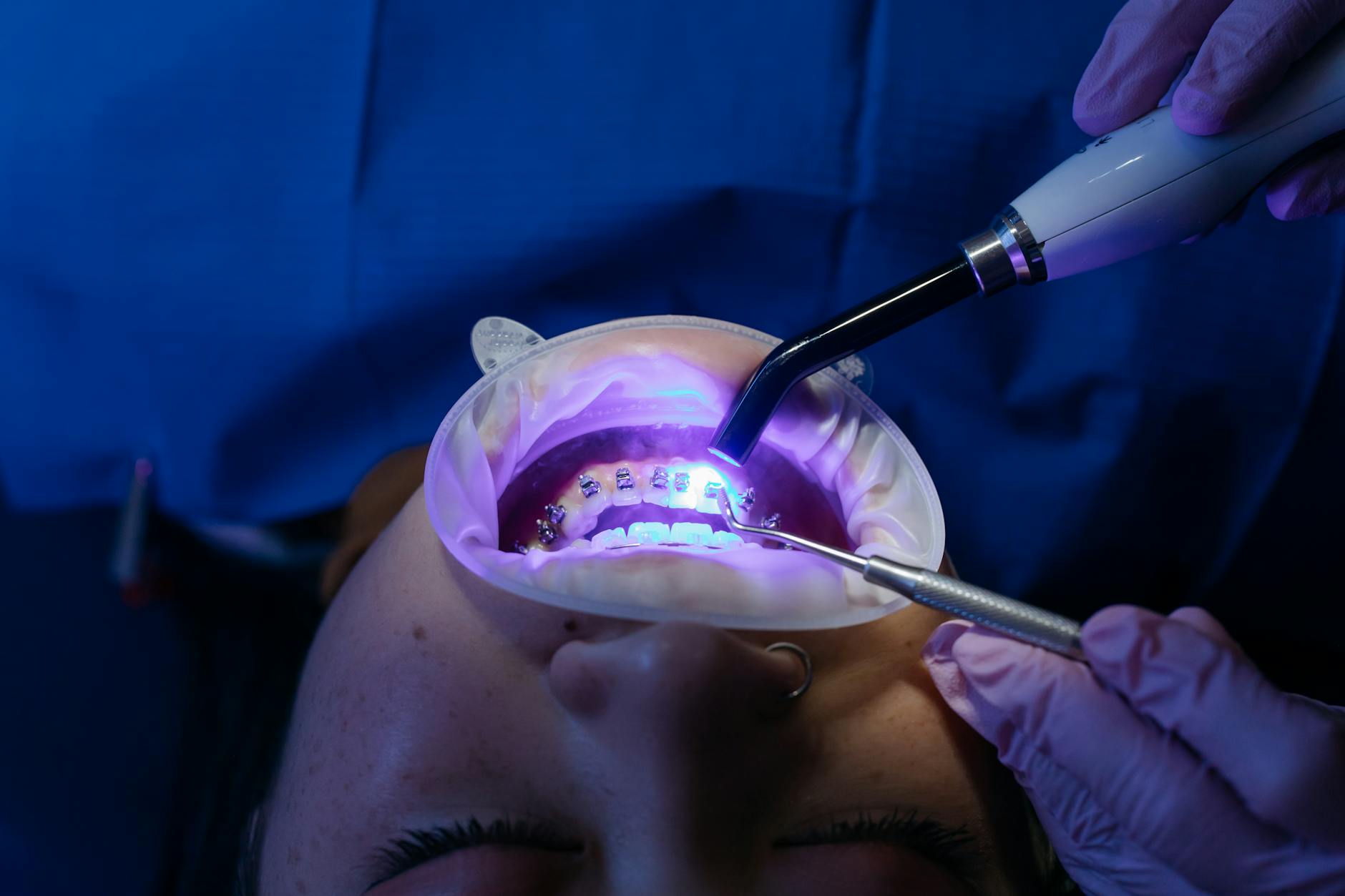
The Laughland NanoLight LED mouthpiece in action — blue light accelerates peroxide penetration for deeper stain removal
The 8:16 formula used in the Laughland system refers to the gel's concentration ratio, calibrated by Dr. Peter TJ Kwon, DDS, to deliver professional-grade oxidation without the sensitivity that typically accompanies high-strength peroxide products. This is specifically relevant for smokers: tobacco use is associated with gum recession and enamel wear, both of which can make high-concentration whitening uncomfortable if the formula isn't carefully balanced. The inclusion of desensitizing agents in the proprietary formula addresses this directly.
Treatment Frequency: What Smokers Need vs. Casual Whitening
Standard whitening protocols recommend 3–5 sessions for most people. If you're dealing with tobacco staining, plan for the full recommended course and potentially a follow-up cycle. The Laughland system is designed around a 6-treatment protocol, which aligns well with what smokers typically need to see meaningful results on intrinsic staining.
Here's a practical comparison of treatment approaches:
| Treatment Type | Peroxide Strength | Sessions Needed (Smokers) | Deep Stain Penetration |
|---|---|---|---|
| Whitening Toothpaste | None (abrasive only) | No real effect | No |
| OTC Whitening Strips | 6–10% H₂O₂ | 10–14+ sessions | Minimal |
| LED Tray System (at-home) | 16–22% Carbamide / 10–12% H₂O₂ | 6–8 sessions | Yes — LED-accelerated |
| In-Office Professional | 25–40% H₂O₂ | 1–2 sessions | Yes — strongest available |
The Laughland system sits in the LED tray category — which for most smokers represents the right balance between efficacy and cost. In-office treatments achieve results faster, but the cost is typically $400–$800 per session, and for current smokers, the results will fade without ongoing maintenance treatment anyway. A quality at-home LED system is both more practical and more economical over time.
Realistic Expectations: How Many Shades Can You Actually Gain?
This is the question that matters most, and the honest answer depends on how long and how heavily someone has smoked, the original shade of their teeth, and how consistently they follow the treatment protocol.
For light-to-moderate smokers (under 10 years, less than a pack per day), a full LED kit protocol typically yields 5–8 shade improvements. The Laughland system is rated for 7+ shades in 6 treatments, which is consistent with what dentist-formulated, LED-accelerated systems typically deliver under ideal conditions. For heavier or longer-term smokers with more significant intrinsic staining, 4–6 shades is a more realistic target for the initial course — still a dramatic visible improvement.
One important note: "can you whiten smoker's teeth completely back to natural white?" is a common question, and the truthful answer is that heavily stained teeth from decades of smoking may not return to the same shade as someone who has never smoked. However, 5–7 shades of visible improvement is transformative in practice — and results with the Laughland system last up to one year, which is meaningful for anyone maintaining ongoing use.
Maintenance Protocol for Current Smokers
If you're still smoking, the realities of maintenance are worth understanding before you invest in any whitening product. Tobacco staining is ongoing, which means any treatment outcome is provisional — staining will return over time without periodic treatment cycles.
A practical maintenance approach for current smokers:
- Initial course: Complete the full 6-session protocol for maximum baseline improvement.
- Brush immediately after smoking when possible — fresh tar deposits are surface-level and easier to disrupt before they bond deeper into the enamel.
- Rinse with water when brushing isn't practical — this dilutes residual tar compounds before they set.
- Monthly touch-up sessions: A single whitening session per month helps maintain the gains from the initial course. Most LED kit formulas include enough gel for extended use.
- Avoid staining foods/drinks immediately post-treatment — the pores in enamel are temporarily more open after whitening, making it easier for new stains to set during the first 24–48 hours.
The Laughland kit's reported one-year durability assumes typical use conditions. For current smokers, monthly maintenance sessions are a realistic part of keeping results visible. The good news is that the kit's price point — currently $39.99, down from $99.99 — makes this economically sustainable compared to repeated in-office visits.
The Laughland Teeth Whitening Kit: Right Tool for the Job
When evaluating how to remove tobacco stains from teeth effectively, the Laughland system checks the critical boxes that smokers need:
- Dentist formulated: Developed by Dr. Peter TJ Kwon, DDS — the formula is calibrated for real-world staining, not just marketing copy.
- Proprietary 8:16 formula: High enough concentration to address intrinsic tobacco staining; balanced with desensitizing agents so the treatment is comfortable even for enamel-compromised smoker's teeth.
- NanoLight LED mouthpiece: Full-arch blue LED coverage accelerates peroxide penetration, which is specifically what separates this category from strips when treating deep staining.
- 6-treatment protocol: Matches what smokers actually need — not a 3-day consumer product designed for mild coffee staining.
- Zero sensitivity formulation: The proprietary gel includes sensitivity-blocking agents, making it usable even for smokers with gum recession or enamel wear.
- Results last up to one year: With proper maintenance, this is among the longest-lasting at-home whitening durations available.
At $39.99 (60% off the standard price), this sits well below the cost of a single professional in-office session while offering a treatment intensity that strips cannot match. For anyone specifically looking for the best whitening kit for smokers, this combination of formulation strength, LED technology, and clinical backing makes it the most practical choice available without a dentist's chair.
Exclusive Discount — $39.99 (Was $99.99)
Final Verdict
Tobacco stains are categorically harder to remove than any other common cause of tooth discoloration — and using the wrong product is why so many smokers give up on whitening entirely after being disappointed by strips. The staining is both surface and intrinsic, tar bonds chemically inside the enamel, and low-concentration products simply don't have the chemistry to break those bonds.
Effective smoking teeth stains treatment requires three things: a high-potency peroxide formula, a delivery method that ensures even full-arch contact, and an LED accelerator that drives the chemistry deeper into the enamel. The Laughland Teeth Whitening Kit delivers all three in a dentist-formulated, sensitivity-conscious package at a fraction of in-office pricing.
For smokers who have written off whitening after years of underwhelming strip results, this is the product that actually matches the problem. Complete the 6-session course, follow a simple monthly maintenance routine, and 7+ shades of improvement is a realistic outcome — not just marketing language.
Limited-Time Offer — Ships Fast
Frequently Asked Questions
Ready to Get Started?
Don't miss out on this exclusive offer!
Claim Your Discount → *This is an affiliate link. We may earn a commission at no extra cost to you.