Emergency Preparedness in 2026: Why Your Phone Battery Could Save Your Life
When a tornado ripped through a small suburb of Nashville in 2020, dozens of residents found themselves cut off from emergency services for hours — not because help wasn't available, but because their phones were dead. They couldn't call 911, couldn't access real-time evacuation routes, couldn't tell family members they were alive. One resident later told local news she had sat in her neighbor's rubble for four hours before someone with a working phone could summon help. The tornado had hit at 1 a.m. Most people had gone to bed with their phones at 30%.
That story is not an outlier. In virtually every major disaster since 2010 — from Hurricane Sandy to the 2023 Maui wildfires to the winter freeze that knocked out Texas's power grid — the consistent, recurring tragedy was the same: people who needed to make a critical call or access a critical app could not do so because their emergency preparedness phone battery planning simply did not exist.
This guide is about changing that. Keeping your phone charged during a crisis is one of the most practical, affordable, and high-impact things you can do for your family's safety. And it requires planning you can complete this weekend.
Why Your Phone Is Your #1 Emergency Tool in 2026
In previous generations, emergency preparedness meant a battery-powered radio, a landline, and a paper map. Today, your smartphone has made all three largely obsolete — but it has also become a single point of failure. If it dies, you lose access to:
- 911 and emergency dispatch — the primary way most Americans contact emergency services
- Wireless Emergency Alerts (WEA) — government alerts for tornado warnings, flash floods, AMBER alerts, and presidential alerts
- FEMA's official app — real-time shelter maps, disaster declarations, and safety checklists
- Family communication — reaching family members to confirm safety or coordinate a meeting point
- Navigation — offline maps for evacuation routes when cellular data is congested or unavailable
- Medical information — health records, medication lists, and insurance cards stored digitally
- Flashlight — a genuine life-safety tool in pitch-black disaster scenarios
None of this works on a dead battery. Emergency preparedness phone battery planning is not a luxury item — it is a core component of any modern disaster readiness plan.
Real Scenarios Where a Dead Phone Has Cost People Dearly

Natural Disasters and Power Outages
When Hurricane Ian made landfall in Southwest Florida in September 2022, it knocked out power to over 2.5 million homes and businesses. Cell towers failed in cascading waves as backup generators ran out of fuel. For many residents, the critical window to call for help, share a location, or receive evacuation orders was limited to whatever charge remained in their phone when the storm arrived. Those who had battery banks, car chargers, or solar panels were able to communicate through the grid outage for days. Those who did not were largely silent.
Winter storms present a slower but equally dangerous version of this problem. The February 2021 Texas freeze left millions without power for days in sub-zero temperatures. Residents trying to locate warming centers or check on elderly neighbors were rapidly draining phones with no way to recharge them.
Medical Emergencies
According to the American Heart Association, the average survival rate for out-of-hospital cardiac arrest is roughly 10%. One of the strongest predictors of survival is how quickly 911 is called and how quickly CPR begins. A dead phone does not call 911. A person experiencing a medical emergency alone — a fall, a stroke, an allergic reaction — may have only seconds to make a call before losing consciousness. In those situations, the phone in their pocket is the only tool that matters, and it needs to be charged.
Car Breakdowns and Roadside Emergencies
AAA responds to approximately 32 million roadside service calls per year in the United States. A growing subset of those cases involves drivers who are stranded on the side of a highway, in a remote area, or in extreme weather — and whose phones have died before they can complete the call. A car breakdown at night on an unfamiliar road with a dead phone is not an inconvenience. In cold weather, in remote terrain, or in high-traffic areas, it can be genuinely life-threatening. A car charger is a $12 solution to a potentially catastrophic problem.
Getting Lost or Stranded Outdoors
Search and rescue teams across the country report that one of the most common factors in extended wilderness rescues is a victim with a dead or dying phone. Modern smartphones can share precise GPS coordinates with emergency services — but only while powered on. Hikers, hunters, and campers in remote terrain should treat battery life as a survival resource no less important than water.
The 72-Hour Rule: What FEMA Actually Says
FEMA's official guidance advises every household to be prepared to be completely self-sufficient for a minimum of 72 hours following a major disaster. The reasoning is straightforward: after a large-scale event — a significant earthquake, a major hurricane, a widespread winter storm — first responders are overwhelmed, roads may be impassable, and outside assistance may simply not arrive for several days.
That 72-hour window is the timeframe against which your emergency phone power backup plan must be measured. If your only charging option is a wall outlet, and the grid goes down, you have exactly as much power as what is already in your devices. Planning for 72 hours of at least minimal phone functionality should be the standard, not a stretch goal.
Building Your Home Emergency Charging Kit

A well-stocked home emergency charging kit does not need to be expensive or technically complex. Here is what a practical, layered approach looks like:
1. Portable Battery Banks
A portable battery bank — also called a power bank — is the single most important piece of how to keep your phone charged in an emergency. These are compact lithium-ion batteries that store electrical charge independently from the grid. A bank with a capacity of 20,000 mAh can typically charge a modern smartphone four to six times before needing to be recharged itself.
Key purchasing criteria for an emergency power bank:
- Minimum 20,000 mAh capacity for meaningful multi-day use
- USB-C Power Delivery (PD) support for faster charging speeds
- Multiple output ports to charge more than one device simultaneously
- A durable, compact form factor that can be stored in a go-bag
- Built-in LED charge indicator so you can check its status at a glance
Keep it charged. This is the most commonly neglected step. A power bank sitting in a drawer at 10% is nearly worthless. Set a quarterly calendar reminder to top it off.
2. Solar Chargers
For extended outages lasting more than 72 hours — or for scenarios where you are displaced from your home — a foldable solar panel charger provides the ability to generate power as long as sunlight is available. Modern portable solar panels can generate enough power to charge a smartphone in three to six hours of direct sun. They are particularly valuable in hurricane zones and wildfire evacuation scenarios, where grid restoration can take weeks.
Look for panels rated at a minimum of 15 watts, with weatherproofing and a built-in charge controller to prevent battery damage from overcharging.
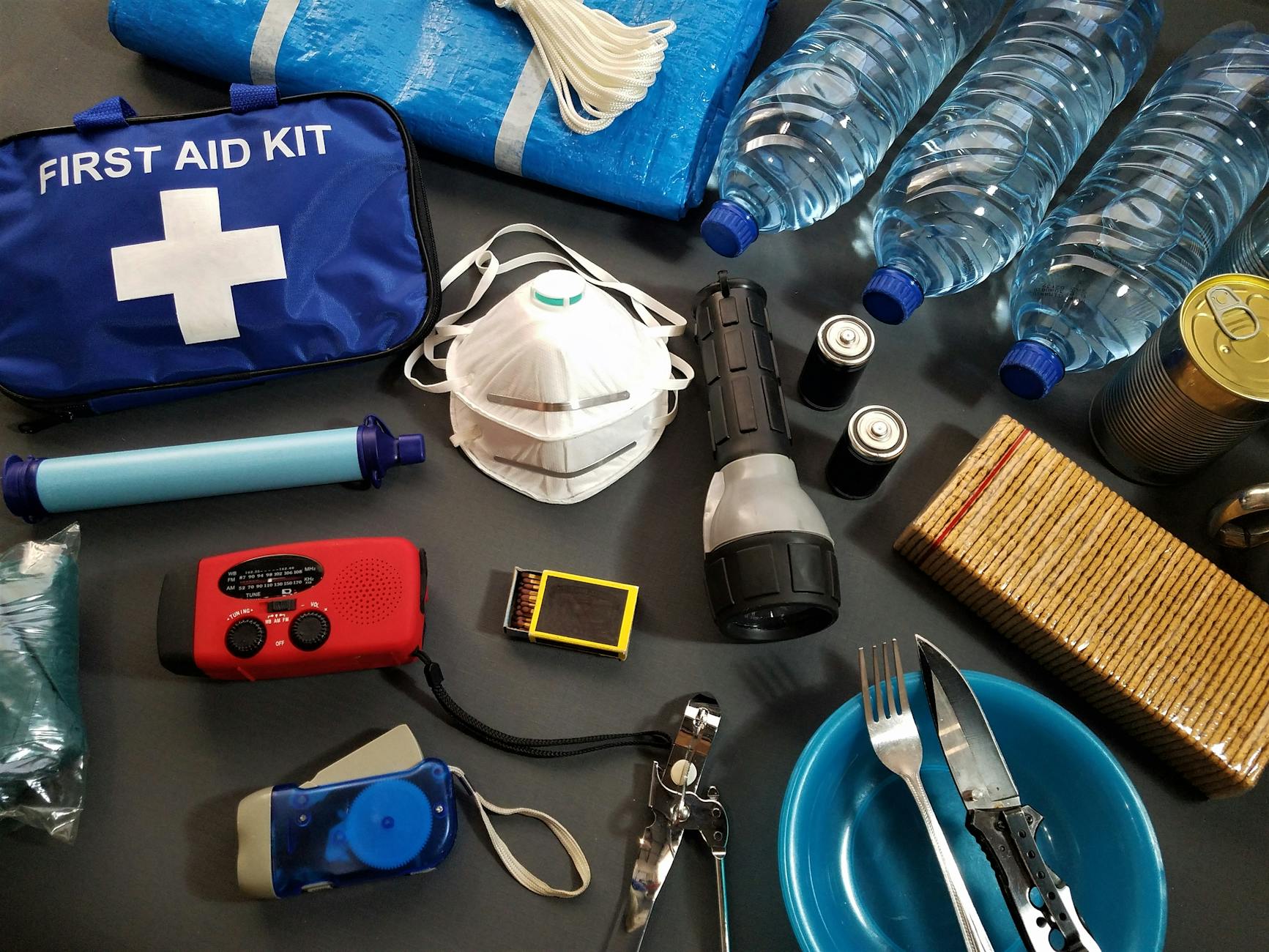
3. Hand-Crank Emergency Radios with USB Output
A hand-crank emergency radio with a built-in USB charging port serves double duty: it provides access to NOAA weather radio broadcasts (the official emergency broadcast system in the US) and can slowly trickle-charge a phone in the absence of any other power source. The charging rate is slow — expect roughly one hour of cranking per 5–10% battery gained — but in a true emergency with no other option, it can provide enough power to make a critical call.
The best models also include solar panels, an AM/FM receiver, and a built-in flashlight, making them one of the most versatile single items you can own for disaster preparedness tech.
4. Uninterruptible Power Supplies (UPS)
A UPS — the same type of device used to protect desktop computers — can be repurposed as a home emergency power station. A mid-sized UPS (around 600–1000VA) can charge multiple phones and keep a router running for several hours after grid power fails. During short outages of one to four hours, which are by far the most common type, a UPS in your home office or living room can prevent any disruption to your devices at all.
Building Your Car Emergency Charging Kit
Your car's 12V system is one of the most underutilized emergency power resources most Americans own. A fully charged car battery contains roughly 700–900 watt-hours of energy — enough to charge a smartphone dozens of times. Accessing that energy requires only inexpensive, widely available hardware. A complete car emergency power kit includes:
- A dual-port USB car charger — plugs into the 12V (cigarette lighter) port; essential and costs under $15
- A USB-C cable rated for fast charging — cheap cables degrade over time; keep a spare in the glove compartment
- A compact power bank in the glovebox — always there, always accessible, pre-charged
- A car jump starter with USB output — dual-purpose: it jump-starts your car AND charges your phone, with most models providing 10,000–20,000 mAh of USB power
- A car emergency radio — battery-powered, receives NOAA weather alerts and AM/FM, stores in the trunk
One important caution: do not leave a power bank in a hot car for extended periods. Lithium-ion batteries degrade rapidly at high temperatures and can, in extreme cases, pose a fire risk. Store power banks at home or in a temperature-controlled area of your vehicle when possible.
What to Charge First During a Power Outage
When the grid goes down and you are working from limited stored power, prioritization matters. Here is a sensible order of operations:
- Primary smartphones first — the devices most likely to be used to call for help, receive alerts, or navigate
- Battery-powered medical devices — CPAP machines, insulin pump controllers, hearing aids, or any device with a direct health impact
- Emergency radio — if battery-powered, keep it charged to receive official alerts without relying on the cellular network
- Tablets and secondary devices — useful for children, entertainment during extended outages, and larger-screen navigation
- Laptops — low priority unless needed for work-from-home during extended events; they consume significantly more power than phones
How to Preserve Phone Battery in an Emergency
When your charge is limited, extending its life is just as important as having backup power. These steps can meaningfully extend battery life during a crisis:
- Enable Low Power Mode immediately — on both iOS and Android, this single toggle can extend battery life by 20–30%
- Reduce screen brightness to minimum — the display is the single largest drain on most smartphones
- Turn off Wi-Fi and Bluetooth if not needed — both continuously scan for connections and drain battery in the background
- Switch to Airplane Mode when not actively using the phone — cellular radios searching for a weak signal in a compromised network use significant power; check in periodically rather than staying constantly connected
- Close all background apps — prevent background refresh and location services from draining power unnecessarily
- Keep the phone warm in cold weather — lithium-ion batteries lose capacity rapidly in cold temperatures; a phone in a warm inner pocket performs significantly better than one left in a cold car
- Send texts instead of making calls — text messages use far less power than voice calls and are more likely to get through on congested networks
Emergency Apps to Download Before Disaster Strikes
Having the right apps installed and configured before a disaster is a critical part of any disaster preparedness tech checklist. Downloading apps during an emergency — with potentially degraded cell service and a draining battery — is exactly the wrong time. Install these now:
- FEMA App (free, iOS and Android) — real-time alerts, shelter maps, and disaster declarations for your location
- Red Cross Emergency App (free, iOS and Android) — hurricane, earthquake, tornado, and wildfire monitoring with one-touch emergency calling
- Google Maps or Apple Maps (downloaded offline) — pre-download offline maps for your region so navigation works without a data connection
- What3Words — assigns a three-word address to every 3-meter square on Earth; increasingly used by emergency services to pinpoint location with precision when a street address is unavailable
- Zello — a push-to-talk walkie-talkie app that works over cellular data or Wi-Fi when voice calls are overwhelmed; widely used during disaster response
- First Aid by Red Cross — step-by-step instructions for hundreds of first aid scenarios, accessible offline
After installing, set up each app and configure your home location, emergency contacts, and notification preferences. An app you have never opened before is significantly less useful under stress.
Testing Your Emergency Preparedness Quarterly
Emergency preparedness is not a one-time purchase. It is a habit. The most common reason emergency kits fail is not that people lack equipment — it is that equipment is never tested, batteries are never recharged, and apps are never updated.
Set a recurring calendar reminder every three months — aligned with daylight saving time changes is a common mnemonic — to run through the following checklist:
- Check the charge level of all battery banks and recharge any below 80%
- Test the hand-crank radio: does it turn on, receive NOAA Weather Radio on 162.400–162.550 MHz, and charge a device?
- Check that all emergency apps are updated and still properly configured
- Verify that offline maps are downloaded and current
- Confirm that all family members know where the emergency kit is stored
- Check cables and adapters for damage or corrosion
- Replace any batteries that no longer hold a reliable charge
A quarterly check takes about 20 minutes. It is one of the highest-return investments of time you will make all year.
Assembling a Complete Emergency Power Kit: A Summary Checklist
For easy reference, here is a consolidated emergency phone power backup and power outage phone charging checklist organized by location:
At home:
- 20,000+ mAh portable battery bank (kept charged)
- Foldable solar panel charger (15W+)
- Hand-crank emergency radio with USB output and NOAA weather capability
- UPS (uninterruptible power supply) for short outages
- Surge protector with multiple USB ports
- Spare USB-C and Lightning cables
In your car:
- Dual-port USB car charger
- Compact power bank in the glovebox
- Car jump starter with USB output
- Spare charging cables
- Battery-powered emergency radio
In a go-bag or evacuation bag:
- High-capacity power bank (20,000+ mAh)
- Small foldable solar panel
- USB-C and Lightning cables (one each)
- Printed emergency contact list (phones can die; paper cannot)
Key Takeaways
The gap between a family that navigates a disaster effectively and one that suffers extended harm is often not about the size of the emergency — it is about preparation. A dead phone in a crisis is not an inconvenience; it is a communications blackout at exactly the moment you need to communicate most.
The emergency preparedness phone battery solutions covered in this guide are not complicated or expensive. A quality power bank, a car charger, a hand-crank radio, and a quarterly habit of testing and recharging your equipment will put you far ahead of the majority of households in your area.
FEMA estimates that fewer than half of American households have an emergency kit of any kind. The time to prepare is before the storm warning is issued, before the earthquake hits, before the grid goes dark. The technology to keep your family connected through those events exists, is affordable, and fits in a shoebox. The only variable is whether you act on it now or later.
Act on it now.
Official Resources
- FEMA Ready.gov — www.ready.gov
- NOAA Weather Radio — www.weather.gov/nwr
- American Red Cross Emergency Preparedness — redcross.org