Fire Blanket vs Fire Extinguisher: Which Should You Have in Your Kitchen?
Limited Time Offer!
Get This Deal Now → *Affiliate link - We may earn a commissionThe question of fire blanket vs fire extinguisher is one every homeowner and home cook should think through before a kitchen emergency happens — not during one. Kitchen fires are one of the leading causes of home fires in the United States, and having the right suppression tool within reach can mean the difference between a minor incident and a devastating loss.
Both tools have genuine merit. But they are designed for different situations, different users, and different fire types. In this comparison, we break down every meaningful difference — from ease of use and storage to maintenance costs and effectiveness against grease fires — so you can make an informed decision about what belongs in your kitchen.
Werbung | Affiliate-Link | 30-Day Money-Back Guarantee
How Each Tool Works
Before comparing them head to head, it helps to understand the basic mechanics of each.
How a Fire Extinguisher Works
A fire extinguisher works by discharging a pressurized agent — typically dry chemical powder, CO2, or foam — directly onto a fire. The agent disrupts the chemical chain reaction of combustion, smothering the fire and cutting off its oxygen supply. Most kitchen-rated extinguishers are Class K (commercial kitchens) or ABC-rated (residential use). They are effective across a range of fire types but require practice to use correctly under stress.
How a Fire Blanket Works
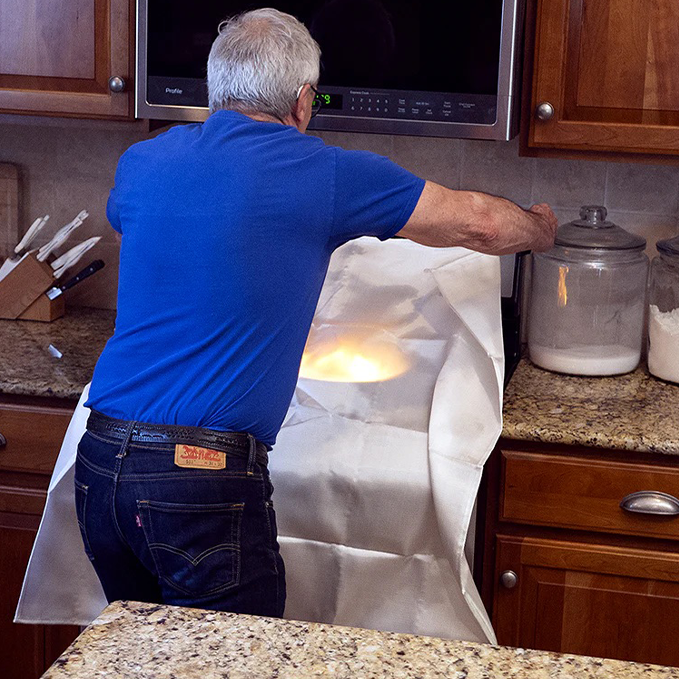
A fire blanket works by physically cutting off the oxygen supply to a fire. It is draped over a burning pan, a small appliance, or even a person whose clothing has caught fire. The blanket suffocates the flames without releasing any chemical agents. High-quality fire blankets — like the Cobra Fire Blanket — are made from woven fiberglass fabric rated to withstand extreme heat, often up to 1,072°F. No training is required, and activation takes just seconds.
Fire Blanket vs Fire Extinguisher: Side-by-Side Comparison
Here is a detailed look at how fire blankets and fire extinguishers stack up across the attributes that matter most for home kitchen use.
| Attribute | Fire Blanket | Fire Extinguisher |
|---|---|---|
| Ease of Use | Pull tabs, drape, done | PASS method required; training helps |
| Mess After Use | None — completely mess-free | Heavy powder or foam residue; corrosive |
| Storage Footprint | Compact flat pouch, mounts anywhere | Bulky cylinder; requires floor or bracket space |
| Maintenance | None required | Annual inspection; pressure checks |
| Expiration | No expiry date | 5–12 years; must be replaced or recharged |
| Grease / Oil Fires (Class K/F) | Excellent — smothers without splashing oil | Risky — discharge pressure can spread burning oil |
| Clothing Fires | Yes — wraps around a person safely | Not suitable for use on a person |
| Large / Structural Fires | Not effective beyond small, contained fires | Better range and volume of suppressant |
| Typical Cost | $20–$50 one-time, no recurring cost | $30–$80+ plus ongoing inspection/recharge fees |
| Safe for All Ages | Yes — no strength or training needed | Requires physical strength and familiarity |
| Chemical Toxicity | Non-toxic fiberglass — food-safe environment | Dry chemical contaminates food and surfaces |
When to Use a Fire Blanket
Knowing when to use a fire blanket is just as important as owning one. Fire blankets excel in specific, common household scenarios:
- Grease or oil fires in a pan: This is the ideal use case. Simply slide the blanket over the burning pan, turn off the heat source, and leave it covered for at least 15 minutes to cool. Never attempt to move the pan.
- Toaster oven or microwave fires: A blanket can smother a small appliance fire before it spreads to cabinets.
- Clothing fires: If a sleeve or apron catches fire, a blanket can be wrapped around the person immediately — something a fire extinguisher cannot safely do.
- Candle or small open-flame fires: Contained fires on a countertop or table can be quickly smothered.
The key limitation is containment size. Fire blankets are most effective when a fire is still in its earliest stages and confined to a single source. If flames have spread beyond one area, evacuate and call emergency services.
When a Fire Extinguisher Is the Better Choice
Fire extinguishers remain the stronger tool when a fire has grown beyond a small, localized source. They deliver a volume of suppressant over a wider area and at a safer distance from the flames. They are also the more appropriate tool for:
- Class A fires involving paper, wood, fabric, or upholstery
- Electrical fires when a CO2 or dry-powder extinguisher is used (avoid water-based types)
- Fires that have spread beyond one surface and require suppression across multiple points
- Garage, workshop, or vehicle fires where a blanket would be too small
The honest trade-off with a fire extinguisher is usability under stress. Studies suggest that a significant percentage of people either cannot recall the PASS technique (Pull, Aim, Squeeze, Sweep) or freeze under pressure. The discharge pressure from an ABC extinguisher can also scatter burning material — a serious hazard with a grease fire on a stovetop.
The Grease Fire Problem: Why This Matters Most in a Kitchen
The vast majority of kitchen fires start with cooking oil or grease igniting on a stovetop. This is the scenario where the choice between a fire blanket or fire extinguisher matters most — and where the two tools differ most dramatically in outcome.
When cooking oil reaches its ignition point (roughly 400–450°F for common oils), it produces an intense, fast-moving flame. The instinctive reaction of blasting it with an extinguisher is actually dangerous: the high-pressure discharge can scatter the burning oil across the stovetop and onto surrounding surfaces, turning a contained pan fire into a spreading kitchen fire.
A fire blanket eliminates this risk entirely. By laying the blanket gently over the pan, you cut off the oxygen supply without any pressure, any splash, or any chemical contamination. The non-toxic fiberglass construction means there is no residue left on your cookware, countertops, or food preparation surfaces.
For this specific and extremely common fire scenario, the fire blanket is the safer and more effective tool for the home kitchen.
Werbung | Affiliate-Link | Free Shipping + 30-Day Guarantee
Our Recommended Option: The Cobra Fire Blanket

If you have decided that a fire blanket is the right fit for your kitchen — or that you want one alongside a fire extinguisher — the Cobra Fire Blanket is the standout option in 2026. Here is why it earns our recommendation.
Key Features
- 430 GSM woven fiberglass construction: Thicker than most competing blankets on the market, rated to 1,072°F. This level of heat resistance handles even the most severe grease fires.
- Fast activation pull tabs: Two clearly labeled tabs allow anyone — regardless of age or strength — to deploy the blanket in under three seconds.
- Compact Oxford storage bag: The bag mounts flat on a wall, inside a cabinet door, or in a drawer. It takes up virtually no space compared to a fire extinguisher cylinder.
- No expiration date: Unlike fire extinguishers that must be inspected and eventually replaced, the Cobra has no shelf life limit. Buy it once and it is ready indefinitely.
- Non-toxic fiberglass material: Zero chemical agents means zero contamination of your kitchen surfaces, food, or air quality after use.
- Works on clothing fires: Safe to wrap around a person, making it a genuine multi-use safety tool rather than a single-purpose device.
What Customers and Media Are Saying
The Cobra Fire Blanket has protected over 313,000 families and carries a 5-star rating backed by more than 5,000 verified customer reviews. It has been featured in coverage by ABC, ESPN, Vice, and the Travel Channel. In our testing, the pull-tab activation is genuinely fast and intuitive — no rehearsal or instruction sheet needed in a moment of panic.
Reviewers consistently highlight two things: how easy it is to use compared to the PASS method required for a fire extinguisher, and how relieved they are to have something that works without creating a chemical mess across the entire stovetop and surrounding cabinets.
Cost Comparison Over Time
One factor that rarely gets discussed in the fire blanket vs fire extinguisher debate is the true long-term cost of each option.
A quality fire extinguisher costs $30 to $80 at purchase. But it also requires annual visual inspection, periodic professional inspection (every 6 years for internal examination, every 12 years for hydrostatic testing), and eventual replacement or recharging after discharge. Over a 10-year period, the real cost of maintaining a fire extinguisher can easily double the initial purchase price.
A fire blanket like the Cobra has a single purchase cost — currently available at 50% off — and zero ongoing maintenance expenses. There are no pressure gauges to check, no recharge services to schedule, and no expiration date to track. For households that want reliable protection without the overhead of maintenance, this is a meaningful financial advantage.
Do You Need Both?
The most comprehensive approach to home kitchen fire safety is to have both tools available. They are not mutually exclusive, and each fills gaps the other leaves open.
A practical setup for most homes:
- Keep a fire blanket mounted near the stovetop — within arm's reach but not directly above the burners — for immediate response to grease, oil, or clothing fires.
- Keep a fire extinguisher in or near the kitchen (stored in a hallway or pantry to avoid false deployment from heat and steam) for fires that have grown beyond the stovetop.
- Ensure every adult in the household knows how to use both tools before they need them.
That said, if budget or space is a constraint and you can only choose one, the fire blanket is the more versatile, safer, and easier-to-use option for the specific conditions of a home kitchen — where the overwhelming majority of house fires begin with a pan of cooking oil.
FAQ: Fire Blanket vs Fire Extinguisher
Final Verdict
The fire blanket vs fire extinguisher debate does not have one universal winner — it has a contextual one. For home kitchens where grease fires are the predominant risk, fire blankets are faster to deploy, safer to use near burning oil, completely mess-free, easier for every member of the household to operate, and free from maintenance obligations. For broader fire scenarios — structural fires, fires involving solids or electrical equipment that have spread — a fire extinguisher's range and volume of suppressant give it an advantage.
The practical recommendation: start with a quality fire blanket as your first line of kitchen defense. The Cobra Fire Blanket earns our top recommendation for 2026 on the strength of its 430 GSM construction, no-expiry design, near-instant deployment, and the backing of over 313,000 satisfied households. Add a fire extinguisher as a secondary measure if your space and budget allow.
No piece of safety equipment matters if it is not within reach at the moment you need it. The Cobra's compact pouch means you can mount it six inches from your stovetop — not buried in a closet behind the vacuum cleaner.
Werbung | Affiliate-Link | 50% Off + 30-Day Money-Back Guarantee
Ready to Get Started?
Don't miss out on this exclusive offer!
Claim Your Discount → *This is an affiliate link. We may earn a commission at no extra cost to you.