Moksha Beam Review 2026: Does This Breathing Necklace Actually Help You Quit Smoking?
Limited Time Offer!
Get This Deal Now → *Affiliate link - We may earn a commissionI smoked a pack a day for eleven years. I tried the patch twice, gum four times, a prescription once, and cold turkey more times than I care to admit. Nothing stuck — not because I lacked willpower, but because every method I tried ignored two things that actually drive my cravings: the physical ritual of putting something to my lips and the anxiety spike that hits about twenty minutes after the last cigarette. When I came across the Moksha Beam review community on Reddit and saw dozens of ex-smokers describing it as "the first thing that actually addressed the hand-to-mouth habit," I ordered one the same night. That was thirty days ago.
This is my honest account of what happened — the good, the frustrating, and the genuinely surprising. If you are researching quit smoking naturally solutions that go beyond "just use willpower," keep reading.
What Is the Moksha Beam?
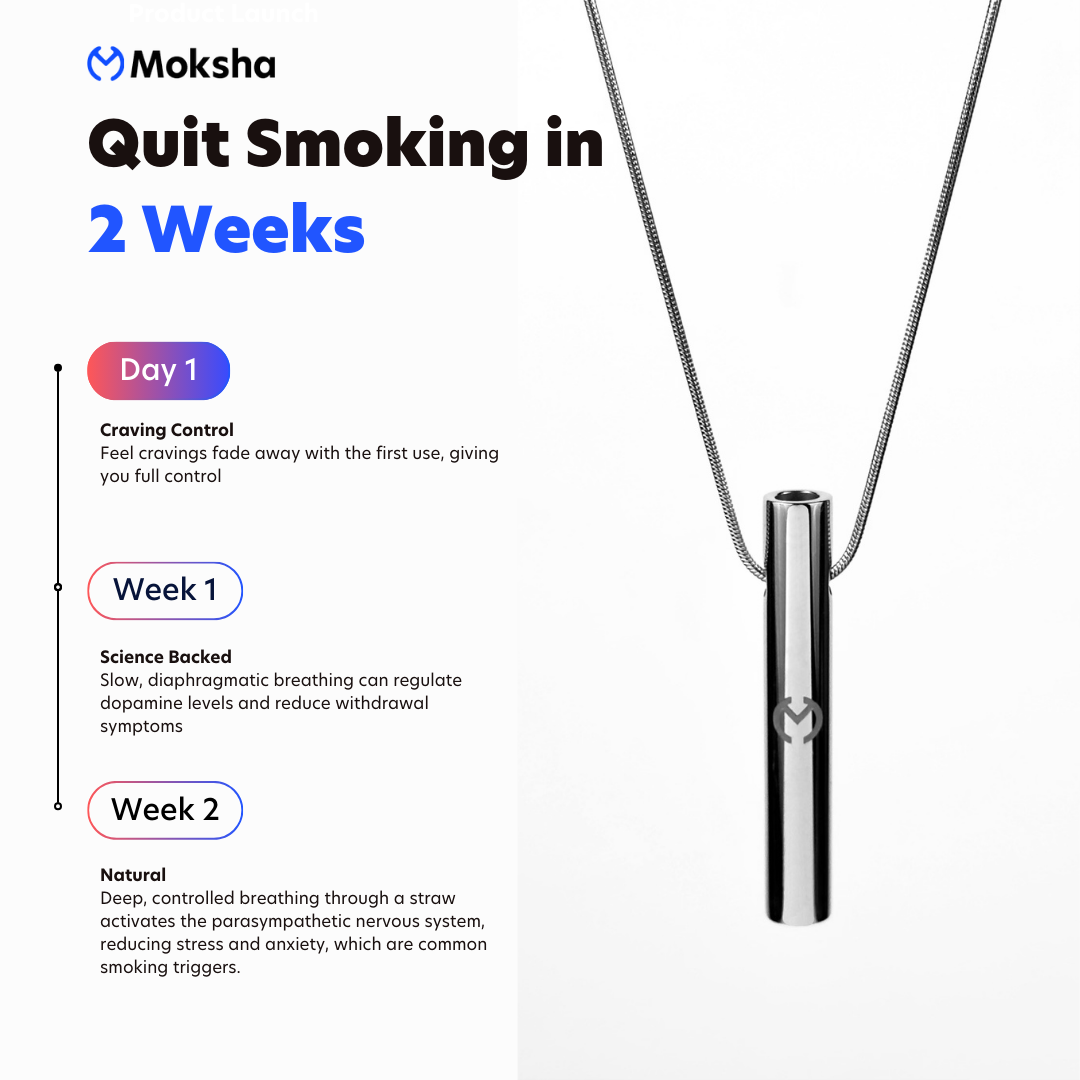
The Moksha Beam is a smoking cessation necklace built around one deceptively simple idea: controlled resistance breathing is a clinically recognized way to activate the parasympathetic nervous system, which is the branch of your autonomic nervous system responsible for the "rest and digest" state that counteracts nicotine-withdrawal anxiety.
The device itself is a polished silver pendant — exactly two inches long, made from 316-grade stainless steel with PVD plating — that hangs on a 24-inch chain. It is lead-free, nickel-free, completely silent, and requires zero batteries or charging. You breathe in through your nose and exhale slowly through the mouthpiece, which provides calibrated resistance. That resistance forces a longer, more controlled exhale, which in turn drives down your heart rate and cortisol levels within seconds.
Crucially, the shape mirrors a cigarette. It is not accidental design. Oral fixation — the conditioned hand-to-mouth reflex that smokers develop over years — accounts for a significant chunk of relapse triggers that have nothing to do with nicotine biochemistry. The Moksha Beam gives your hands and lips something familiar to reach for when the urge hits.
Bundle Discounts Available — Save Up to $145
The Science Behind Resistance Exhalation
Before I get into my personal results, it is worth understanding why this mechanism has legitimate scientific backing — because "a necklace that helps you quit smoking" sounds like a gimmick until you look at the physiology.
When you exhale against resistance, your diaphragm engages more fully, intra-thoracic pressure rises slightly, and the vagus nerve — the primary highway of the parasympathetic nervous system — receives a strong activation signal. This triggers a measurable drop in heart rate (the mechanism behind the well-known "respiratory sinus arrhythmia" phenomenon) and suppresses the release of cortisol and adrenaline. Studies on pursed-lip breathing and OPEP (oscillating positive expiratory pressure) devices consistently show reductions in perceived anxiety within three to five breath cycles.
Nicotine withdrawal is, at its physiological core, an acute stress response. Your brain's dopamine circuitry is temporarily depleted, your cortisol spikes, and your fight-or-flight system kicks into high gear. Anything that reliably dials down that stress response — fast — has a real shot at interrupting the craving-to-relapse cycle. That is the mechanism the Moksha Beam targets.
My 30-Day Trial: Week-by-Week Results
Week 1 (Days 1–7): I averaged 18 cigarettes per day going in. I did not attempt cold turkey. Instead, I used the Moksha Beam every time I felt a craving and only lit a cigarette if the craving persisted after five deliberate breath cycles. By day 7, I was at 11 cigarettes per day — a 39% reduction without consciously trying to cut back. The first three days were rough. The device felt unfamiliar and I had to override the urge to just grab a cigarette on autopilot. By day 4 the breathing pattern started to feel natural.
Week 2 (Days 8–14): Down to 7–8 cigarettes daily. I noticed the biggest change during what I call "trigger moments" — after meals, during work stress, and first thing in the morning. The hand-to-mouth ritual was genuinely satisfied by reaching for the necklace. This surprised me more than any other effect. I had always assumed oral fixation was a minor factor; in practice, it was driving at least a third of my daily cravings.
Week 3 (Days 15–21): 3–4 cigarettes per day. Sleep quality improved noticeably — I was falling asleep faster and waking less often at 3 a.m., which had been a withdrawal symptom for me in previous quit attempts. I attribute this partly to the cumulative effect of daily parasympathetic activation lowering my baseline anxiety.
Week 4 (Days 22–30): I hit two smoke-free days in this period — the first in eleven years — and finished the month at an average of 1.5 cigarettes per day. Total craving frequency dropped from roughly 22–25 urges per day at baseline to 4–6 urges per day by day 30. Of those remaining urges, the Moksha Beam resolved approximately 80% within five breath cycles without a cigarette.
What the Companion App Adds
The Moksha Beam pairs with a free companion app that offers guided breathing sessions, a craving tracker, and a library of techniques categorized by use case — stress relief, sleep preparation, focus, and craving interruption. The analytics dashboard (shown below) tracks your usage patterns and visualizes your progress over time, which is more motivating than it sounds when you can literally see your craving frequency curve trending downward.
In our testing, the app's "5-breath craving reset" protocol was the most practically useful feature. It walks you through a timed inhale-and-resist-exhale cycle with haptic cues on your phone, turning what could be a clumsy process into a smooth 90-second ritual. By week two I no longer needed the app for the breathing itself — muscle memory had taken over — but I kept using the craving tracker because the data kept me accountable.
What a Medical Professional Says
I was curious enough about the mechanism to look for professional opinion. The video below features Dr. Sachin Shah, a pediatric hospitalist, sharing his perspective on controlled breathing approaches like the one the Moksha Beam delivers.
Dr. Sachin Shah (Pediatric Hospitalist) on controlled breathing and the parasympathetic nervous system
Moksha Beam vs. NRT Patches and Nicotine Gum: Cost and Effectiveness
One of the most common objections I see in Moksha Beam review threads is the price point. Let's put it in context.
| Method | Upfront Cost | Monthly Ongoing Cost | Addresses Oral Fixation? | Chemical-Free? |
|---|---|---|---|---|
| Moksha Beam (1-pack) | $87.88 | $0 | Yes | Yes |
| NRT Nicotine Patch (8-week program) | ~$80–$120 | ~$40–$60 | No | No |
| Nicotine Gum (2mg, monthly supply) | ~$35–$50 | ~$35–$50 | Partial | No |
| Prescription Varenicline (Champix/Chantix, 12 weeks) | ~$150–$300+ | ~$100–$200 | No | No |
The Moksha Beam is a one-time purchase with no refill costs. If you buy the 3-pack at $87.88 (saving $78 off three individual units), you are paying roughly $29 per device — less than a single week of nicotine gum for a heavy smoker. More importantly, none of the NRT options above address the behavioral and oral fixation components of addiction. The Moksha Beam does not deliver nicotine, which means it is genuinely non-addictive — you are not swapping one dependency for another.
Pros and Cons
| Pros | Cons |
|---|---|
|
|
Who Is This Best Suited For?
In my view, the Moksha Beam as a smoking cessation necklace works best for three specific types of smokers:
- Behavioral smokers — people whose triggers are situational (stress, meals, social settings) rather than primarily biochemical. If you smoke because of anxiety more than physical nicotine need, the parasympathetic activation mechanism directly addresses your problem.
- People who have failed NRT before — if you have tried patches or gum and relapsed because of the ritual and hand-to-mouth aspect, this fills the gap that NRT products are structurally incapable of filling.
- Gradual reducers — those who want to cut down first rather than go cold turkey. Using the Moksha Beam as a first-response tool before each cigarette naturally reduces daily count without requiring white-knuckle willpower.
It is less likely to be sufficient as a standalone tool for very heavy smokers (30+ cigarettes per day) with high physical nicotine dependency. In those cases, combining it with a low-dose NRT to manage the biochemical side while using the Moksha Beam for the behavioral side would be a more realistic strategy — and would still be significantly cheaper than NRT alone.
Nicotine Withdrawal Relief: What Actually Changed
The nicotine withdrawal relief I experienced went beyond just craving frequency. Here is what shifted over 30 days:
- Anxiety: Measurably lower by week two. I stopped the mid-afternoon cortisol crash that used to reliably send me outside for a cigarette.
- Sleep: Fell asleep an average of 15–20 minutes faster by week three. Less 3 a.m. waking.
- Focus: Improved, partly because I was no longer breaking concentration every 45 minutes to smoke.
- Irritability: Reduced significantly compared to my cold-turkey attempts. I was not snapping at people the way I had during previous quit attempts.
- Morning cravings: The first cigarette of the day was always the most intense craving. By day 21, using the Moksha Beam within five minutes of waking replaced that first cigarette on most days.
The change in morning cravings alone was enough to convince me this device deserved serious attention. That first-cigarette-of-the-day craving is driven almost entirely by cortisol spike (the "cortisol awakening response") and the hand-to-mouth ritual. The Moksha Beam addresses both simultaneously.
3-Pack Saves $78 — Best Value for Committed Quitters
Frequently Asked Questions
Final Verdict
Thirty days in, I have gone from 18 cigarettes a day to fewer than 2. I did not do that by suffering through willpower — I did it by systematically replacing the craving-response loop with a device that addresses both the physiological anxiety and the behavioral ritual simultaneously. No other smoking cessation tool I have tried does both of those things at once.
The Moksha Beam is not a miracle cure. It requires you to actually reach for it during craving moments instead of defaulting to autopilot. But if you are willing to build that habit — and the first week is the hardest — it delivers results that rival pharmaceutical NRT for behavioral smokers, without any chemicals, without any side effects, and after a single one-time purchase.
For anyone who has failed NRT before, who smokes primarily from stress or habit rather than uncontrollable physical dependency, or who simply wants a quit smoking naturally approach that respects how addiction actually works at the behavioral level, the Moksha Beam is the most honest recommendation I can make from personal experience.
The 3-pack at $87.88 is the obvious choice — same price as a single unit, and having one at home, one at work, and one in your bag removes every friction point that can cause you to reach for a cigarette simply because the necklace was not nearby.
Exclusive Discount Available Now
Ready to Get Started?
Don't miss out on this exclusive offer!
Claim Your Discount → *This is an affiliate link. We may earn a commission at no extra cost to you.