Why Your Fitted Sheet Keeps Coming Off — and 7 Things That Actually Fix It

You made your bed before sleep. You woke up at 2 a.m. to a corner of the fitted sheet curled into a rope near your feet, the mattress corner exposed, and your entire sleeping surface rearranged. If you find yourself asking why does my fitted sheet keep coming off, you are not alone — and it is not just bad luck. There are specific, fixable reasons this keeps happening, and most people never address the actual cause.
This guide breaks down the real culprits behind a slipping fitted sheet and gives you 7 ranked solutions — from zero-cost technique fixes to inexpensive accessories — so you can finally get a night of sleep without wrestling your bedding back into place.
The Actual Reasons Your Fitted Sheet Will Not Stay Put
Before you can fix the problem, you need to understand why it is happening. A fitted sheet slips for one of a handful of root causes, and most of them come down to a mismatch between the sheet and the mattress.
1. The Sheet's Pocket Depth Does Not Match Your Mattress
This is the most common — and most overlooked — reason a fitted sheet keeps slipping off. Mattress depths vary enormously. A basic innerspring mattress might be 8–10 inches tall. Add a pillow-top and you are at 12–14 inches. Add a separate mattress topper and you could easily be at 16–18 inches or more.
Most standard fitted sheets are designed for mattresses up to 12–14 inches deep. If your sleeping surface is taller than the sheet's pocket, the elastic is constantly under tension, stretching to hold on — and eventually losing the fight. The corner pops off, usually starting at the foot of the bed where it gets the least attention and the most movement from your feet at night.
The fix starts with measuring your mattress (plus any topper) from the floor up to the sleeping surface — not the mattress alone. Then check the "pocket depth" listed on your sheet packaging. You want at least an extra inch of clearance, ideally two.
2. The Elastic Has Stretched Out or Was Poor Quality to Begin With
Elastic degrades. Heat from washing and drying, age, and repeated stretching all reduce its holding power over time. If your sheets are more than a few years old and have been washed frequently, the elastic band may simply no longer have the tension it needs to grip the underside of a mattress.
Cheaper sheets often use elastic only at the four corners — a small patch rather than a full perimeter band. This "four-corner" elastic design is far less effective than all-around elastic that runs the full length of each side. When you buy sheets, look for the phrase "full elastic band" or "360-degree elastic" on the packaging. That continuous band distributes grip evenly and dramatically reduces slipping.
3. Your Mattress Surface Itself Is Slippery
Some mattress materials — particularly memory foam and latex — are inherently slicker than traditional innerspring mattresses. Memory foam has a dense, smooth surface that gives sheets very little to grip. Similarly, many mattress protectors are made from vinyl or polyester-based fabrics that are designed to be water-resistant, which also makes them frictionless.
If you recently switched to a foam mattress or added a mattress protector and noticed the slipping started immediately, the surface is likely the issue rather than the sheet itself.
4. Sheet Material and Weave Play a Bigger Role Than You Think
The fabric of the sheet matters as much as the elastic. Satin and microfiber sheets are notorious for sliding — they are engineered to feel silky-smooth, which means there is almost no friction between the sheet and the mattress. The same properties that make them feel luxurious make them terrible at staying in place.
Percale-weave cotton and linen sheets have a slightly rougher, matte texture that grips mattress surfaces far better. If you love the feel of smooth sheets but hate the slipping, the elastic quality and pocket depth become even more critical — you cannot rely on fabric friction to do any of the work.
The Tucking Technique Most People Get Wrong
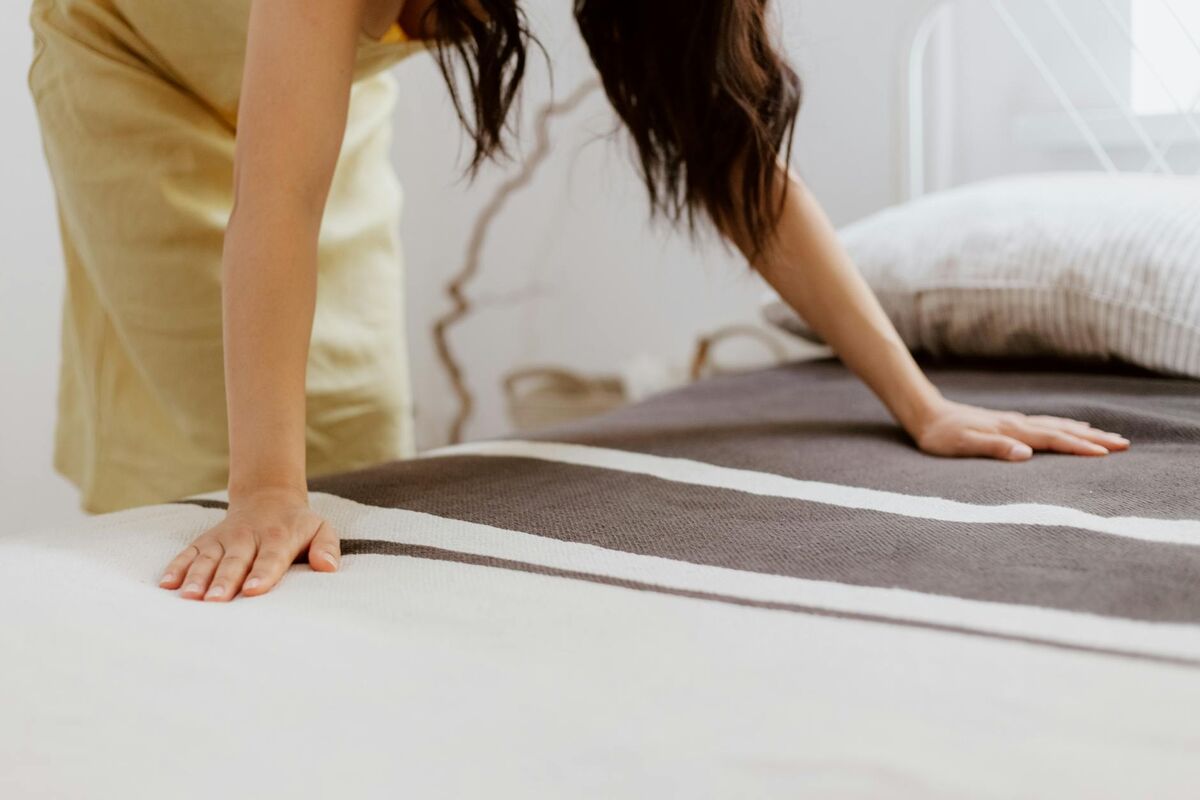
Even with a perfectly sized sheet and strong elastic, how you put the sheet on affects how well it stays. Most people throw the sheet over the mattress and push the corners on. That is the wrong approach.
The Hospital Corner Method
Hospital corners — the same tight, angular tuck used in military bunks and hotel beds — create a mechanical lock that friction alone cannot replicate. Here is how to do it properly:
- Pull the sheet up tightly over the mattress corner and let the excess hang down the side.
- Grab the side edge of the hanging fabric about 12 inches up from the foot and lift it onto the mattress, creating a diagonal fold.
- Tuck the remaining hanging portion under the mattress as tightly as possible.
- Lower the folded flap back down and tuck it firmly under the mattress as well.
- The result is a tight 45-degree triangular fold at each corner that physically locks the sheet in place.
This technique is not just for flat sheets. You can apply the same principle to fitted sheets by ensuring the corner pocket is pressed fully down onto the mattress corner before tucking any excess side fabric underneath. The deeper you tuck, the less movement the sheet experiences during the night.
Start at the Head, Not the Foot
Another common mistake: most people start fitting the sheet at a foot corner, then work their way around. Instead, fit both head corners first, pulling the sheet taut before moving to the foot. Gravity and sleeping movement pull everything toward the foot of the bed, so anchoring the head end first gives you a foundation to pull against.
How Mattress Toppers Make the Problem Significantly Worse
If you use a mattress topper — whether for comfort, temperature regulation, or joint support — you have introduced a second layer that moves independently of the mattress beneath it. A fitted sheet slipping solution that works on a bare mattress may fail completely when a topper is added, for two reasons.
First, the topper increases the total sleeping surface height, as described above. A sheet that fit perfectly before the topper was added may now be operating at the absolute limit of its pocket depth — or beyond it.
Second, the topper itself can migrate. If the topper shifts even slightly during the night, it takes the sheet with it, creating a compounding effect. The topper moves, the sheet follows, and by morning you have a bunched mess at one corner.
The most effective response to this specific problem is to address the topper first. Many toppers come with their own attachment straps that anchor them to the mattress. If yours does not have them, you can buy non-slip pads designed to sit between the mattress and the topper to create friction and stop migration entirely. Once the topper is stable, the sheet problem often resolves itself.
7 Proven Solutions Ranked by Effort and Effectiveness
Now for the part you actually came here for. These are the most effective answers to how to keep sheets on bed, ranked from easiest to most involved.
1. Check and Correct Your Pocket Depth (Effort: Low / Effectiveness: Very High)
Measure your mattress height including any topper, then buy sheets with a pocket depth at least 1–2 inches deeper. This single change solves the problem for the majority of people who deal with fitted sheet slipping. Deep-pocket sheets designed for mattresses 15–22 inches tall are widely available and typically cost no more than standard sheets.
2. Use Sheet Suspenders or Bed Sheet Straps (Effort: Low / Effectiveness: High)
Sheet suspenders — also called sheet straps or bed sheet clips — attach to the underside of the mattress and clip onto the sheet fabric, holding it in place from below. They work on the same principle as trouser suspenders: constant tension from multiple anchor points. A set of four corner straps, or a crosswise strap that runs underneath the entire mattress, can eliminate slipping almost entirely regardless of mattress height or sheet material. This is one of the most reliable bed sheet hacks that work for difficult setups.
3. Switch to an All-Elastic Band Sheet (Effort: Low / Effectiveness: High)
If your current sheets have four-corner elastic only, replacing them with a sheet that has a continuous elastic band running all the way around the perimeter will make an immediate difference. The full band grips the underside of the mattress at every point rather than relying on four stressed anchor points to hold the whole sheet.
4. Add a Non-Slip Mattress Pad or Gripper (Effort: Low / Effectiveness: Medium-High)
A thin non-slip pad — similar to the shelf liner used in kitchen cabinets — placed between the mattress and the fitted sheet creates surface friction that keeps the sheet from sliding. These are inexpensive, cut to any size, and particularly effective on foam and latex mattresses where the smooth surface is the core of the problem. They are also useful under mattress toppers to stop topper migration.
5. Use Safety Pins at the Corners (Effort: Low / Effectiveness: Medium)
Safety pins through the sheet and into the mattress fabric at each corner are an old-fashioned but genuinely effective fix. Pin the elastic edge of the sheet to the side of the mattress at each corner, and the pins act as mechanical anchors. The limitation is wear on the sheet fabric over time and the need to re-pin after each wash. But for a quick fix or travel situation, it works.
6. Apply the Hospital Corner Technique (Effort: Medium / Effectiveness: Medium-High)
As described above, a proper hospital corner creates a physical tuck that resists movement far better than simply pulling the elastic over the corner. Combined with any of the above solutions, it gives you redundancy — the elastic holds, and the tuck provides a backup lock.
7. Replace Old or Low-Quality Sheets (Effort: Medium / Effectiveness: Very High)
If your sheets are several years old or were low-cost to begin with, the elastic may simply be too degraded to hold regardless of technique. Replacing them with quality sheets — look for long-staple cotton with a full perimeter elastic band and the correct pocket depth — is the most comprehensive fix. It costs more than a set of straps, but it addresses the root cause rather than compensating for it.
Solution Comparison: At a Glance
The table below summarizes the seven solutions so you can quickly find the right approach for your situation.
| Solution | Effort | Effectiveness | Cost | Best For |
|---|---|---|---|---|
| Correct pocket depth | Low | Very High | $$ (new sheets) | Tall mattresses / toppers |
| Sheet suspenders / straps | Low | High | $ | Any mattress / slippery fabric |
| Full-perimeter elastic sheet | Low | High | $$ | Replacing corner-only elastic |
| Non-slip mattress pad | Low | Medium-High | $ | Foam / latex mattresses |
| Safety pins | Low | Medium | Free | Quick fix / travel |
| Hospital corner tucking | Medium | Medium-High | Free | Standard setup / any sheet |
| Replace old sheets | Medium | Very High | $$$ | Worn-out or low-quality sheets |
Frequently Asked Questions
Key Takeaways
- The most common cause of a fitted sheet slipping off is a mismatch between pocket depth and mattress height — always measure before buying sheets.
- Four-corner elastic is significantly weaker than a full perimeter band; look for "360-degree elastic" on sheet packaging.
- Foam and latex mattresses have smooth surfaces that give sheets nothing to grip — a non-slip pad resolves this quickly and cheaply.
- Satin and microfiber sheets slide more than percale or linen because they are engineered to be frictionless.
- Mattress toppers compound the problem by adding height and introducing a second mobile layer — anchor the topper before trying to fix the sheet.
- Hospital corners create a mechanical tuck that holds far better than simply pulling the elastic over the mattress corner.
- Sheet suspenders are the most universally effective fitted sheet slipping solution regardless of mattress type, and they work with any sheet you already own.
- High-heat drying degrades elastic faster than almost anything else — wash on warm and dry on low to extend your sheets' usable life.
The next time you find yourself asking why does my fitted sheet keep coming off, work through this list from the top. Start with pocket depth, check your elastic, and consider your mattress surface. In most cases, the problem is completely solvable without spending much money — it just requires knowing what you are actually fixing.